Part One
So, identity. What is identity? It's a label, I suppose. A badge that we wear. It tells us who and what we are, and who and what we are not. It comes as a source of security in a perilous world, a fixed point in a universe where the sands are ever-shifting. It is a reference point to which we can return in times of uncertainty. It describes what we like and dislike, approve of and disapprove; what we think and how we think, what we believe and stand for. In extreme cases, it may remove the need to think for ourselves altogether: just refer to the ready-made booklet of personal identity. Take on an ideology, even better.
With our identity recognised, we can sleep certain and secure in our bed at night. Which is all absolutely fine, apart from one little thing...….
Identity is an illusion.
There may be a time in our earlier years when exploring our identity is a significant, possibly necessary, step. The moment arrives, however, when, particularly for anyone aspiring to a life beyond the pig trough, identity has to be analysed, understood, then softened, unpicked, dissolved. We have to open up - in Buddhist terms, see the impermanent as just that -, and resist the temptation to load this fantasy fabrication with too much value, too much weight. We exit the castle to enter into direct communication with the rest of the universe.
Dissolving identity, by the way, is not the same as 'dissolving the ego'. The word 'ego' is one of those infinitely problematic ones. But to the extent that it denotes a sense of self, it needs to be firm yet flexible; confident, strong. Paradoxically, it requires a strong ego to be able to safely dissolve personal identity. You need a good sense of who you are in a natural, spontaneous way before you can throw away the badges.
There is a point where even the identities which were long considered helpful and 'positive' have to go. Spiritual identity, for example. Being 'a Buddhist' was a good step (at least I think so) for quite a while, but eventually became an impediment. No such reference point needed any more.
There are people who seem extremely keen to stick an identity label on me. It is as if, without the badge, they find it difficult to know how to relate to another person at all (try - living direct, without veils). In recent times, I have been asked a number of times whether I am 'right wing'. It seems that believing in free speech and minimal government interference acts as an attractor to the 'right wing' label. No, I am not right-wing! I am not any wing. I haven't got wings at all, at least not in this dimension. I am who I am, full stop. Get over it.....
Identity, belief, ideology: three notions with much in common. All substitutes for real living. Jettison belief in order to communicate directly with Other. Chuck all ideology in the bin, and live instead from grace.
Part Two
I have in front of me a publication so slim that it barely qualifies to be called a booklet. It was produced in 1978, and is authored by my former Buddhist teacher. It is titled 'The True Individual'.
My former teacher always insisted that whatever he said could be connected back to the core, the root principles of Buddhism. In this he may or may not have been correct. Yes or no, I invariably found his most interesting, indeed 'enlightening', words to be those emanating from the more maverick side of his being.
The spiritual aspirant he likened to this true individual. This, in turn, was contrasted with the person who was merely a member of 'a group', or 'the group'. The distinguishing factor of the true individual was the emergence and cultivation of self-awareness, by means of which he or she broke free of the unconscious conditioning which bound them to the herd mentality of the group. Like the Tarot Fool, the true individual wandered free of the mass mind; the Buddha was the truest of true individuals.
To complicate matters slightly, my teacher also posited the existence of the 'positive group' (a normal group was assumed to be largely negative in nature, being unconscious and full of people who were easily manipulated as a result). The positive group existed to further the aims of developing individuals, a kind of launchpad and support system. Traditionally, a wider community of people supporting a monastic bunch of Buddhist full-timers might fit this mould. Personally, I find it all a bit questionable, but there we go.
He also elucidated upon 'love mode', which characterised the actions of individuals; and 'power mode', which was the more typical dynamic among group members. Then some smart ass began hypothesising about using 'power at the service of love', at which point the whole thing started to fall apart.
At another point during this period of Buddhist maverick teachings, my former teacher likened the Buddha - or a highly self-aware individual - to a ghost and a madman. Good images. The Buddha, the fully realised Fool, is slippery, elusive, ungraspable. There is no fixed identity to grab hold of and 'understand' (thereby imagining control over the situation). And in their unorthodox unpredictability, their transcendence of identities, they appear mad to those who are label-obsessed, those transfixed by the values of the group.
Part Three
Identitarian politics sucks. It's as simple as that. It continually reinforces folks' group allegiances, then pits them against one another in an eternal war of badges. Muslims against Christians, women against men, blacks against whites, gays against straights, fixed gender people against gender fluids, Muslims against the rest of the world. The list goes on.
It's a recipe for unending strife. Which is a bit paradoxical, since the official message is that it's all about some kind of equality, about bringing peace and harmony by making us all the same. Blacks given the same 'rights' as whites, gays the same as straights, and so on. But the result is precisely the contrary of a society of peaceful equality. People are encouraged to discover their (group) identity, nurse it, then take it as a weapon against the rest of the world. Disaster - unless, of course, your aim is to quietly encourage ferment, giving you indefinite reasons to introduce yet more controls and regulations on the unruly masses. Not that anyone would dream of implementing such a nefarious plan.
One group pitted against another. And the soup becomes still more poison since the dynamic is that of victim and perpetrator. One group of bastards behaving badly against another group of poor helpless victims. Victims: women, gay people, immigrants, blacks, transgender folk; all 'minority' groups, so the narrative goes. Perpetrators: white people and their cultures, especially white males, the big baddies in a world of otherwise lovely people.
It goes without saying that a world conceived of in terms of victimhood is not exactly character building. It frames people within a picture of personal weakness, and of being wronged. Rather than getting out of bed in the morning and taking responsibility for their own life. So we need rules, regulations, bannings, censorships, to help right these horrible wrongs. This is the substance out of which modernity with its identitarianism is wrought. Yes indeed, it sucks.
Saturday, 20 April 2019
More Words, More Words:Liberty
Part One
Here's another Penguin 'editorial note', written by one Helena Kennedy: liberty. 'Liberty is individual freedom, of which there are two forms: firstly, a sense of freedom and release from the chains of external control (negative liberty), and secondly an internal freedom of choice (positive freedom). This also entails the notion of self-determination, which leads to inequality with others. It can also involve the taking of risks, which may not lead to the desired outcome.'
Plenty to mull over there. One problem only: '...…. which leads to inequality with others.' The words 'equality' and 'inequality' are doorways to such a pandora's box, as to end up being meaningless, really. My own life is too short and precious to spend the rest of its limited span in discussion of the issues connected with these most vague and emotionally-propelled words. If we substitute 'difference' for 'inequality', we may get closer to the truth of the matter.
We can now begin to dimly perceive this strange reality: there are two distinct types of human being. There are those who see 'freedom', 'liberty', as the basis of a healthy human society, and as the axis on which human aspiration can be properly fulfilled. And there are those who see fit to control others; who are certain of their rightness, and furthermore seek to silence and otherwise disempower anyone who happens to disagree with them. We had a peek into this infernal world in the previous post.
These two types of being also manifest the broader meaning of the 'telestai/gnostics versus illuminati' dichotomy which John Lash describes, again outlined in a recent post. There are those who seek gnosis, and there are those who endeavour to lord it over others, be it out of nefariousness or self-righteousness. This is the focal division among human beings, I suggest. Not right v left, Christians v Muslims, Christians v atheists, or whatever.
Part Two
Any social/political notions which may turn up on Pale Green Vortex are a direct mirror of what, for want of a better term at the moment, I'll call my spiritual life. Not a term I feel completely happy with, but I don't want to get too nit-picky or literalistic just now.
My approach to 'spiritual life' is nowadays highly individualistic. Self-determination is the key. Actually, I've always been like that, it's only recently that I've become vividly aware of it. The individualistic flavour is only accentuated when one sees how much of 'the world' as described by official sources, by the mainstream, is a fabrication, designed to manipulate you and most likely lead you far from your own divinity. You're on your own, buddie, you're on your own.
Self-determination doesn't mean that you don't attend meditation classes, join study groups, have friends, meet and learn from like-minded people. All this may be what you need to do. But it's you, and you alone. You are unique, and any connection you may have with Buddha, God, spirit, whatever, will be unique as well.
I benefitted from a considerable period of living within a context of 'organised Buddhism', but the time came when I had to say goodbye to all that. I required the freedom to wake up in the morning and believe, feel, experience, do anything without bias, prejudgement, or preconceived notions about how life works. If I felt I needed to put pictures of Donald Trump, Teresa May or Lady Gaga all over my bedroom walls, I needed to be internally free to act without a little voice asking 'Yes, but is it Buddhism? Is it consistent with Buddhist principles?' Even the smallest voice putting the questions would have meant death to me. In all honesty, I have thrived since leaving behind any allegiance to a religion, group, movement, or what have you.
An 'aspirational soul' on its unique spiritual journey may survive, flourish even, regardless of the socio-political climate and system it turns up in: 'to gnosis' may be the destiny and purpose of that particular life, come what may. At the same time, different set-ups will encourage or squash that aspirational force to varying degrees. I haven't heard of a lot of Buddha-minds emerging from Soviet Russia.
I have done my share of trashing the shortcomings and inadequacies of modern western societies, I confess to that one. But despite their shortcomings, they remain more favourable to the individual than most others on the planet currently. Above all, there is - or has been - a recognition, at least a cursory nod of the head, in the direction of that most precious of attributes: liberty.
Part Three
It's a never-ending game, a game of cat-and-mouse. The forces that would sever us from liberty, that very simple freedom to think and say what we feel to be right; and the force of humanity trying to discover itself, to be its unique yet universal. Today, the bases of 'positive liberty' are under serious attack. With the cat out of the bag (lots of felines in this paragraph) in the form of internet spread of information, the dark controllers are desperately attempting to exert their authoritarian will and put it back in the bag.
In retrospect, it has probably been folly to go along with the incredible centralisation that has characterised the growth of internet technology. It means in effect handing over great power to a mere handful of gigantic tec organisations. This in turn makes removing an undesirable's voice all that much easier. But there we are, as Facebook, Amazon, and the rest, come down on those who refuse to play the game - which consists primarily of globalisation, counterfeit sameness, the cloak of multiculturalism, and silencing of dissent.
That a human being might wish to control another's freedom of mind, through restricting their free access to opinion and information, strikes me as ridiculous. It is one of the worst things that one can do to a fellow human being. 'Liberty' being the focal point of higher human aspiration. Conversely, it goes without saying that anybody wishing to control others will try to cut off the path to authenticity, realisation of uniqueness. We have 'climate change deniers'; we have 'holocaust deniers'; we also have 'aspiration deniers'. And they are out there in force.
Video link: Oh man, YouTube won't link to the vid. 'Video unavailable'. Must be a coincidence, folks, it's available. Go to YouTube, it's there. Search for 'Sargon of Akkad, To Honour the Dissidents.' 5 minutes, well presented, well worth it.
Here's another Penguin 'editorial note', written by one Helena Kennedy: liberty. 'Liberty is individual freedom, of which there are two forms: firstly, a sense of freedom and release from the chains of external control (negative liberty), and secondly an internal freedom of choice (positive freedom). This also entails the notion of self-determination, which leads to inequality with others. It can also involve the taking of risks, which may not lead to the desired outcome.'
Plenty to mull over there. One problem only: '...…. which leads to inequality with others.' The words 'equality' and 'inequality' are doorways to such a pandora's box, as to end up being meaningless, really. My own life is too short and precious to spend the rest of its limited span in discussion of the issues connected with these most vague and emotionally-propelled words. If we substitute 'difference' for 'inequality', we may get closer to the truth of the matter.
We can now begin to dimly perceive this strange reality: there are two distinct types of human being. There are those who see 'freedom', 'liberty', as the basis of a healthy human society, and as the axis on which human aspiration can be properly fulfilled. And there are those who see fit to control others; who are certain of their rightness, and furthermore seek to silence and otherwise disempower anyone who happens to disagree with them. We had a peek into this infernal world in the previous post.
These two types of being also manifest the broader meaning of the 'telestai/gnostics versus illuminati' dichotomy which John Lash describes, again outlined in a recent post. There are those who seek gnosis, and there are those who endeavour to lord it over others, be it out of nefariousness or self-righteousness. This is the focal division among human beings, I suggest. Not right v left, Christians v Muslims, Christians v atheists, or whatever.
Part Two
Any social/political notions which may turn up on Pale Green Vortex are a direct mirror of what, for want of a better term at the moment, I'll call my spiritual life. Not a term I feel completely happy with, but I don't want to get too nit-picky or literalistic just now.
My approach to 'spiritual life' is nowadays highly individualistic. Self-determination is the key. Actually, I've always been like that, it's only recently that I've become vividly aware of it. The individualistic flavour is only accentuated when one sees how much of 'the world' as described by official sources, by the mainstream, is a fabrication, designed to manipulate you and most likely lead you far from your own divinity. You're on your own, buddie, you're on your own.
Self-determination doesn't mean that you don't attend meditation classes, join study groups, have friends, meet and learn from like-minded people. All this may be what you need to do. But it's you, and you alone. You are unique, and any connection you may have with Buddha, God, spirit, whatever, will be unique as well.
I benefitted from a considerable period of living within a context of 'organised Buddhism', but the time came when I had to say goodbye to all that. I required the freedom to wake up in the morning and believe, feel, experience, do anything without bias, prejudgement, or preconceived notions about how life works. If I felt I needed to put pictures of Donald Trump, Teresa May or Lady Gaga all over my bedroom walls, I needed to be internally free to act without a little voice asking 'Yes, but is it Buddhism? Is it consistent with Buddhist principles?' Even the smallest voice putting the questions would have meant death to me. In all honesty, I have thrived since leaving behind any allegiance to a religion, group, movement, or what have you.
An 'aspirational soul' on its unique spiritual journey may survive, flourish even, regardless of the socio-political climate and system it turns up in: 'to gnosis' may be the destiny and purpose of that particular life, come what may. At the same time, different set-ups will encourage or squash that aspirational force to varying degrees. I haven't heard of a lot of Buddha-minds emerging from Soviet Russia.
I have done my share of trashing the shortcomings and inadequacies of modern western societies, I confess to that one. But despite their shortcomings, they remain more favourable to the individual than most others on the planet currently. Above all, there is - or has been - a recognition, at least a cursory nod of the head, in the direction of that most precious of attributes: liberty.
Part Three
It's a never-ending game, a game of cat-and-mouse. The forces that would sever us from liberty, that very simple freedom to think and say what we feel to be right; and the force of humanity trying to discover itself, to be its unique yet universal. Today, the bases of 'positive liberty' are under serious attack. With the cat out of the bag (lots of felines in this paragraph) in the form of internet spread of information, the dark controllers are desperately attempting to exert their authoritarian will and put it back in the bag.
In retrospect, it has probably been folly to go along with the incredible centralisation that has characterised the growth of internet technology. It means in effect handing over great power to a mere handful of gigantic tec organisations. This in turn makes removing an undesirable's voice all that much easier. But there we are, as Facebook, Amazon, and the rest, come down on those who refuse to play the game - which consists primarily of globalisation, counterfeit sameness, the cloak of multiculturalism, and silencing of dissent.
That a human being might wish to control another's freedom of mind, through restricting their free access to opinion and information, strikes me as ridiculous. It is one of the worst things that one can do to a fellow human being. 'Liberty' being the focal point of higher human aspiration. Conversely, it goes without saying that anybody wishing to control others will try to cut off the path to authenticity, realisation of uniqueness. We have 'climate change deniers'; we have 'holocaust deniers'; we also have 'aspiration deniers'. And they are out there in force.
Video link: Oh man, YouTube won't link to the vid. 'Video unavailable'. Must be a coincidence, folks, it's available. Go to YouTube, it's there. Search for 'Sargon of Akkad, To Honour the Dissidents.' 5 minutes, well presented, well worth it.
Tuesday, 9 April 2019
Book of Words
Part One: King Penguin
Yes, the book of words. The dictionary. An important book, I'd say.
It was one of Neil Kramer's less glorious moments. It hails from a few years back, when I listened to everything he put out, most of which was just what I needed. Anyhow, on this particular day he was in conversation with an interviewer, I've forgotten who, when the discussion turned to words and their meanings. They talked about dictionaries and their importance. It's an online resource now, they agreed, the dictionary. "Who uses a book dictionary nowadays anyway?" almost scoffed Neil, in tones usually reserved for Remainers when they 'talk' about Brexit people.
My ears perked up notably at this point. I use book dictionaries. You know, the ones that stand on the bookshelf. And I feel it is wise indeed to do so. Online resources are all very well, but they are so defined by 'now'. As meanings and nuances change, so will online definitions. Should we wish to understand a word more fully by checking its origins and former meanings, then a book is a far more durable witness to truth and reality than anything to be found online.
There are three dictionaries in our house which regularly come off the bookshelf. There is the English - French dictionary, which is just beginning to look a bit tired around the edges. There is the English - Spanish one which, due to the continued parlous state of my own Spanish-speaking abilities, has recently fallen into three pieces. And there is the New Penguin English Dictionary.
The Penguin is an interesting case. It's big, heavy, hardback. It came my way after my mother died about fifteen years ago. Printed in 2000, it is recent enough to still be current and relevant. Yet it hails from a time when people seemed more at ease to write what they actually thought and felt. The Penguin dictionary comes with a low fear factor.
A feature of this book which caught my attention is that some words are accompanied by 'usage notes' or 'editorial notes'. I came across a couple of these comments recently, which shed bright light on the implications or connotations of words highly relevant to today's human condition.
Part Two: Socialism's little problem
Penguin dictionary, Editorial note, by Professor Peter Clarke on: socialism: 'The social emphasis in socialism is shown by the fact that, in the 19th century, it was contrasted often with individualism rather than with capitalism. The democratic state apparently offered a means of achieving socialism by consent - a strategy to which social democrats adhered, despite electoral setbacks, while Communists instead opted for the shortcut of revolution and autocracy.'
The professor's note is revealing indeed. The primary aim of socialism, according to the editorial note, is the establishment of the socialist state. The means is secondary. If we need to go through this whole tiresome democratic process, so be it. But if the aim can be achieved otherwise, so much the better. The democratic process - the will, the wishes, of 'the people' - is irrelevant. This is the unresolveable paradox of socialist doctrine: that it purports to establish a collective system for the benefit of 'the people', while simultaneously regarding the wishes of those people as unimportant. I suggest that this brings to light the real aim of 'socialism', which is to implement an authoritarian system of collectivism, within which a small number of elites rule the roost over the vast mass of human insignificances.
'Socialism': we're not talking Michael Foot and Keir Hardie here. We're talking anyone who places emphasis on the collective rather than the individual. Who thinks 'Big State' as the means to achieving this end. Who thinks rules and regulations, orders and restrictions, over personal freedom, autonomy, and individual incentive. Interference and control as panaceas. We're thinking 'one-fit' politics where everybody is reduced to the same.
So we're talking about the politics of New Labour as it was, Tony Blair; Obama, Hilary Clinton; Macron, Merkel, the great wet dream of the EU; Nicola Sturgeon, Nick Clegg, now at
Facebook; centrist, 'respectable' members of the British Conservative Party. All fit neatly into this authoritarian mould. None have much respect for the individual's freedoms.
Freedom. Yes, freedom. It should be the most basic of attributes, or aims, of any decent human society. Yet freedom, and its waning mirror image, democracy, is such a fragile little flower. Hard-won, but so easily trampled on. Its erosion, and the lack of respect it gets in some quarters, are what provoke me to write about it in the first place.
Two recent-ish events stand out. Firstly, post-Brexit vote. Some 'Remainers' have shown their own true, rather ugly, colours in its wake. They haven't got their own way, and are not happy. This in itself is fair enough. But when people attempt to overturn the majority vote, or demand a re-run, or even simply dismiss all Brexit people as idiots or old fogeys, then they are playing the dark socialist game, where democracy can happily take second place to the more important end, that of staying in the EU. It is the crass arrogance of the 'socialist liberal elite', who are so certain of their superiority, that they will ride roughshod over the majority verdict if they can only find a way.
Part Three: No more words
Then, as well as Brexit, there is social media. The Thought Police, necessary for any jolly good authoritarian society, have been out in force. We knew it was going to happen. While the internet has facilitated the sharing of information and ideas in ways that were previously unimaginable, still it was inevitably going to be used to filter and shape what people receive and believe to be true. Especially once most of the world has, rather foolishly, become dependent on a small number of organisations as its source of nearly everything.
What started as a trickle has become, just recently, a Niagara. Banning, censoring, 'deplatforming' are the order of the day. The first high-profile critic of the mainstream to be taken down was Alex Jones. Tommy Robinson has followed, and there will be more. Anybody even bold enough to express support for these miscreants is at risk: Swedish independent journalist Katerina Janouch was recently suspended from Facebook after simply expressing support for Tommy Robinson's stance in an article on freedom of expression. It is ridiculous, laughable, and scary. 1984 in overkill. It's sometimes difficult to believe that this is happening right now....
This is the socialist mindset in feeding frenzy. Remember: democracy, freedom of expression, are optional; the end justifies the means. And if that means shutting people up, so be it. Nowadays people are not 'disappeared' by a knock on the door at dawn and a meeting with the firing squad: this does not bring in votes, people take exception. Instead, the authoritarian righteous ones feel fit to silence them by attempting to remove them from the public realm. Silenced, tongues cut off, those speakers of words and opinions inconvenient to the bigger programme.
Pressure from politicians and similar seems to often be behind much of this modern-day censorship. In the UK, various ne-er-do-wells from the Labour Party are especially zealous. 'Thug' (a word often used in the mainstream before Mr. Robinson's name) Tom Watson, deputy Labour leader, is one such, believing he has the right to decide for the population at large who they can listen to and who is forbidden.
Those under the cosh are invariably people of a populist, nationalist frame of mind. This is the big giveaway. People who dare to point out that the multicultural global society (read 'one-world socialism') comes with its problems. That it is not automatically for the benefit of all. Any other point of view is tolerated on mainstream social media; this is the one and only exception. It is being dealt with ruthlessly. Do you get the picture?
A particularly touchy subject is Islam. Just mention it and you will be deleted from Facebook tomorrow. It is Tommy Robinson's main crime, to criticise some aspects of Muslim religion and society. You don't do that any more. It's actually one of the weird things. Before 9/11, nobody really cared too much. Then, two apparently opposing things came into being. Firstly, we were informed that there were a whole number of terrorists attacks in and on western societies, all committed by Islamic terrorists. Simultaneously, it became increasingly bad to criticise or question anything about Islam, to the point where today it has acquired the status of a protected religion. While it is absolutely fine to have a go at Christianity, you utter a word of reservation about Islam at your peril. Can you get your head around this contradiction? It's just surreal. But people seem to get away with it.
To be yawningly clear, once more. This is not about whether Tommy Robinson is a good guy, or whether Islam is the perfect religion. It's about freedom to communicate, and by implication the dignity of the individual. There are those who consider themselves in a position to tell others what they can say, and by implication think. Which facts and opinions the public at large is permitted to hear. And there are other people who are not happy with this authoritarianism. Not at all.
And to be yawningly clear yet again: I am not suggesting that everybody who considers themselves a socialist, liberal progressive, whatever, adheres to the advancement of 1984 as I have outlined it. But it is a factor, and you can't get away from it.
That's it for now. Back with another juicy word shortly.....
Yes, the book of words. The dictionary. An important book, I'd say.
It was one of Neil Kramer's less glorious moments. It hails from a few years back, when I listened to everything he put out, most of which was just what I needed. Anyhow, on this particular day he was in conversation with an interviewer, I've forgotten who, when the discussion turned to words and their meanings. They talked about dictionaries and their importance. It's an online resource now, they agreed, the dictionary. "Who uses a book dictionary nowadays anyway?" almost scoffed Neil, in tones usually reserved for Remainers when they 'talk' about Brexit people.
My ears perked up notably at this point. I use book dictionaries. You know, the ones that stand on the bookshelf. And I feel it is wise indeed to do so. Online resources are all very well, but they are so defined by 'now'. As meanings and nuances change, so will online definitions. Should we wish to understand a word more fully by checking its origins and former meanings, then a book is a far more durable witness to truth and reality than anything to be found online.
There are three dictionaries in our house which regularly come off the bookshelf. There is the English - French dictionary, which is just beginning to look a bit tired around the edges. There is the English - Spanish one which, due to the continued parlous state of my own Spanish-speaking abilities, has recently fallen into three pieces. And there is the New Penguin English Dictionary.
The Penguin is an interesting case. It's big, heavy, hardback. It came my way after my mother died about fifteen years ago. Printed in 2000, it is recent enough to still be current and relevant. Yet it hails from a time when people seemed more at ease to write what they actually thought and felt. The Penguin dictionary comes with a low fear factor.
A feature of this book which caught my attention is that some words are accompanied by 'usage notes' or 'editorial notes'. I came across a couple of these comments recently, which shed bright light on the implications or connotations of words highly relevant to today's human condition.
Part Two: Socialism's little problem
Penguin dictionary, Editorial note, by Professor Peter Clarke on: socialism: 'The social emphasis in socialism is shown by the fact that, in the 19th century, it was contrasted often with individualism rather than with capitalism. The democratic state apparently offered a means of achieving socialism by consent - a strategy to which social democrats adhered, despite electoral setbacks, while Communists instead opted for the shortcut of revolution and autocracy.'
The professor's note is revealing indeed. The primary aim of socialism, according to the editorial note, is the establishment of the socialist state. The means is secondary. If we need to go through this whole tiresome democratic process, so be it. But if the aim can be achieved otherwise, so much the better. The democratic process - the will, the wishes, of 'the people' - is irrelevant. This is the unresolveable paradox of socialist doctrine: that it purports to establish a collective system for the benefit of 'the people', while simultaneously regarding the wishes of those people as unimportant. I suggest that this brings to light the real aim of 'socialism', which is to implement an authoritarian system of collectivism, within which a small number of elites rule the roost over the vast mass of human insignificances.
'Socialism': we're not talking Michael Foot and Keir Hardie here. We're talking anyone who places emphasis on the collective rather than the individual. Who thinks 'Big State' as the means to achieving this end. Who thinks rules and regulations, orders and restrictions, over personal freedom, autonomy, and individual incentive. Interference and control as panaceas. We're thinking 'one-fit' politics where everybody is reduced to the same.
So we're talking about the politics of New Labour as it was, Tony Blair; Obama, Hilary Clinton; Macron, Merkel, the great wet dream of the EU; Nicola Sturgeon, Nick Clegg, now at
Facebook; centrist, 'respectable' members of the British Conservative Party. All fit neatly into this authoritarian mould. None have much respect for the individual's freedoms.
Freedom. Yes, freedom. It should be the most basic of attributes, or aims, of any decent human society. Yet freedom, and its waning mirror image, democracy, is such a fragile little flower. Hard-won, but so easily trampled on. Its erosion, and the lack of respect it gets in some quarters, are what provoke me to write about it in the first place.
Two recent-ish events stand out. Firstly, post-Brexit vote. Some 'Remainers' have shown their own true, rather ugly, colours in its wake. They haven't got their own way, and are not happy. This in itself is fair enough. But when people attempt to overturn the majority vote, or demand a re-run, or even simply dismiss all Brexit people as idiots or old fogeys, then they are playing the dark socialist game, where democracy can happily take second place to the more important end, that of staying in the EU. It is the crass arrogance of the 'socialist liberal elite', who are so certain of their superiority, that they will ride roughshod over the majority verdict if they can only find a way.
Part Three: No more words
Then, as well as Brexit, there is social media. The Thought Police, necessary for any jolly good authoritarian society, have been out in force. We knew it was going to happen. While the internet has facilitated the sharing of information and ideas in ways that were previously unimaginable, still it was inevitably going to be used to filter and shape what people receive and believe to be true. Especially once most of the world has, rather foolishly, become dependent on a small number of organisations as its source of nearly everything.
What started as a trickle has become, just recently, a Niagara. Banning, censoring, 'deplatforming' are the order of the day. The first high-profile critic of the mainstream to be taken down was Alex Jones. Tommy Robinson has followed, and there will be more. Anybody even bold enough to express support for these miscreants is at risk: Swedish independent journalist Katerina Janouch was recently suspended from Facebook after simply expressing support for Tommy Robinson's stance in an article on freedom of expression. It is ridiculous, laughable, and scary. 1984 in overkill. It's sometimes difficult to believe that this is happening right now....
This is the socialist mindset in feeding frenzy. Remember: democracy, freedom of expression, are optional; the end justifies the means. And if that means shutting people up, so be it. Nowadays people are not 'disappeared' by a knock on the door at dawn and a meeting with the firing squad: this does not bring in votes, people take exception. Instead, the authoritarian righteous ones feel fit to silence them by attempting to remove them from the public realm. Silenced, tongues cut off, those speakers of words and opinions inconvenient to the bigger programme.
Pressure from politicians and similar seems to often be behind much of this modern-day censorship. In the UK, various ne-er-do-wells from the Labour Party are especially zealous. 'Thug' (a word often used in the mainstream before Mr. Robinson's name) Tom Watson, deputy Labour leader, is one such, believing he has the right to decide for the population at large who they can listen to and who is forbidden.
Those under the cosh are invariably people of a populist, nationalist frame of mind. This is the big giveaway. People who dare to point out that the multicultural global society (read 'one-world socialism') comes with its problems. That it is not automatically for the benefit of all. Any other point of view is tolerated on mainstream social media; this is the one and only exception. It is being dealt with ruthlessly. Do you get the picture?
A particularly touchy subject is Islam. Just mention it and you will be deleted from Facebook tomorrow. It is Tommy Robinson's main crime, to criticise some aspects of Muslim religion and society. You don't do that any more. It's actually one of the weird things. Before 9/11, nobody really cared too much. Then, two apparently opposing things came into being. Firstly, we were informed that there were a whole number of terrorists attacks in and on western societies, all committed by Islamic terrorists. Simultaneously, it became increasingly bad to criticise or question anything about Islam, to the point where today it has acquired the status of a protected religion. While it is absolutely fine to have a go at Christianity, you utter a word of reservation about Islam at your peril. Can you get your head around this contradiction? It's just surreal. But people seem to get away with it.
To be yawningly clear, once more. This is not about whether Tommy Robinson is a good guy, or whether Islam is the perfect religion. It's about freedom to communicate, and by implication the dignity of the individual. There are those who consider themselves in a position to tell others what they can say, and by implication think. Which facts and opinions the public at large is permitted to hear. And there are other people who are not happy with this authoritarianism. Not at all.
And to be yawningly clear yet again: I am not suggesting that everybody who considers themselves a socialist, liberal progressive, whatever, adheres to the advancement of 1984 as I have outlined it. But it is a factor, and you can't get away from it.
That's it for now. Back with another juicy word shortly.....
Friday, 5 April 2019
Get 'Im!
From time to time there appear characters who, it is deemed by the fair and wise, must be dealt with. Silenced. Obliterated from the public domain. People who speak truth, uncomfortably so; who arouse from sleep other people. Troublemakers.
One such was Jim Morrison. Unlike other icons of the age who were able to whip up a teenage frenzy, such as the Who and Rolling Stones, Morrison also came with a critique, a razor-sharp mind, when he wasn't completely out of it. He was demonised, wrongly accused of 'lewd behaviour', made to flee to Paris, where he died an ignoble death.
Timothy Leary was another. Pied Piper of psychedelia: drop out, everybody. That's not the right message; could not be tolerated. He rendered himself harmless in later years when he adopted the then-novel 'virtual realities' as his enthusiasm. Wilhelm Reich, another. Maybe his inventions were too close to the bone. He died in prison, a broken man, I suppose. You see, 'they' don't care whether you live or die; except that 'organised death' which does not appear to be caused by 'them' is preferable.
And today we have Tommy Robinson. Cut to the quick: hounded relentlessly by a bunch of authoritarian bastards. Nasty people, who preach tolerance, so long as you don't disagree with them. Shameless politicians try to get this sort of thing set up, and spineless pathetic social media corporations bow down before them. Friends, we live in dark times, in some respects at least. So much so that there will be more on this theme shortly.
https://www.youtube.com/watch?v=Ny9bVn6Kf6g
One such was Jim Morrison. Unlike other icons of the age who were able to whip up a teenage frenzy, such as the Who and Rolling Stones, Morrison also came with a critique, a razor-sharp mind, when he wasn't completely out of it. He was demonised, wrongly accused of 'lewd behaviour', made to flee to Paris, where he died an ignoble death.
Timothy Leary was another. Pied Piper of psychedelia: drop out, everybody. That's not the right message; could not be tolerated. He rendered himself harmless in later years when he adopted the then-novel 'virtual realities' as his enthusiasm. Wilhelm Reich, another. Maybe his inventions were too close to the bone. He died in prison, a broken man, I suppose. You see, 'they' don't care whether you live or die; except that 'organised death' which does not appear to be caused by 'them' is preferable.
And today we have Tommy Robinson. Cut to the quick: hounded relentlessly by a bunch of authoritarian bastards. Nasty people, who preach tolerance, so long as you don't disagree with them. Shameless politicians try to get this sort of thing set up, and spineless pathetic social media corporations bow down before them. Friends, we live in dark times, in some respects at least. So much so that there will be more on this theme shortly.
https://www.youtube.com/watch?v=Ny9bVn6Kf6g
Tuesday, 2 April 2019
Bad Bad Corporation
It was nine years ago, April 2nd 2010, just a few short weeks after Pale Green Vortex made its glorious entrance onto the internet. The BBC made its first most inglorious appearance on this site. I suggested that, rather than watching BBC Breakfast in the morning, you might be better off with kiddies' programmes. 'Bear Behaving Badly' was particularly recommended.

A lot can change in less than a decade, and not just ones personal perceptions. BBC Breakfast, Victoria Derbyshire, BBC 'News', Panorama, Newsnight and the rest: it is now widely recognised that nobody in their right minds will tune in to these trashy propaganda specials any more. The credibility of the BBC has plummeted, as have its 'news' and documentary ratings. Maybe there is a light at the end of the Kali Yuga after all.
I recently read a book on the topic. Yes, we seem to be doing books on Pale G.V. at present. Relatively hot off the press, it was: 'BBC: Brainwashing Britain?' by David Sedgwick. Familiar territory, I thought to myself; no sweat. It's actually quite a big tome. And with page after page after 387 pages of BBC 'news' and current affairs being inspected, dissected, analysed, I was in quite a strange mood by the end.
I knew that the BBC was bad. But I had failed to absorb just how totally, utterly, unremittingly bad it is. When it comes to 'news', that much-lauded impartiality is quietly and cunningly jettisoned. Instead it is socio-political conditioning that is remorseless and relentless, purpose-designed to wear down the critical faculties of the viewer. It's not that most of the content is fine, with just the occasional hiccup. Everything, but everything, is viewed through a particular-coloured lens: liberal elitism, cultural Marxism, socialist multiculturalism, power-addictive globalisation, call it what you will. It is there, unmistakeable, once you know how to look.
If you have ever read George Orwells' '1984', you have probably never forgotten it. If you have never read it, well, it's not too late. It's a nightmare dystopian future that Orwell conjures up. When I last read it, about five years ago, even then I found it rather exaggerated. No longer. David Sedgwick, the author, refers to '1984' frequently when describing the ideal society envisaged by BBC types, and the many underhand tactics employed in order to try and bring about their elitist authoritarian vision of society. Selection, omission, distortion, personal smear campaigns, invoking of simplistic good versus bad scenarios, careful choice of language designed to persuade and manipulate: all is everyday fayre in the impartial world of the BBC. Nothing is too low to use, provided it works. Fake news is the norm at Broadcasting House.
The author focusses on two themes to highlight the propaganda nature of BBC (mis)reporting: its ceaseless anti-Trump stance, and its equally ceaseless anti-Brexit pose. He could equally have chosen other topics, such as the BBC's 'coverage' of the themes of climate change and so-called renewable energy. It was my own dip into the realities surrounding these topics which initially alerted me to the strange interpretation of the word 'impartial' by the BBC.
None of what I have written is intended as rhetoric or exaggeration. For once, a Pale Green blogpost can be taken pretty much literally. So too the content of 'BBC: Brainwashing Britain?'. Unlike much of what comes out of Broadcasting House, it is properly researched, not depending on rumour, tweets, or press releases. The BBC is indeed a most dangerous organisation, and it is with relief that I observe how many other people are realising the same. I suppose that, in their increased desperation to perpetuate unsustainable narratives, the BBC's tactics are becoming increasingly obvious, increasingly stupid and over-the-top.
In describing so clearly the nefarious means by which the BBC tries to manipulate the UK populace, the book also provides the reader with valuable tools of discernment which can be used equally with regards to anybody else's 'news'.
So I'm going to heartily recommend this book. If every adult in the UK read it, the nation would become a wiser, better place, more aligned with honesty and reality. And Broadcasting House could be used for something constructive and useful.
As a postscript, the website of the book's author, David Sedgwick, includes his blog, which provides well-written worthwhile pieces.

A lot can change in less than a decade, and not just ones personal perceptions. BBC Breakfast, Victoria Derbyshire, BBC 'News', Panorama, Newsnight and the rest: it is now widely recognised that nobody in their right minds will tune in to these trashy propaganda specials any more. The credibility of the BBC has plummeted, as have its 'news' and documentary ratings. Maybe there is a light at the end of the Kali Yuga after all.
I recently read a book on the topic. Yes, we seem to be doing books on Pale G.V. at present. Relatively hot off the press, it was: 'BBC: Brainwashing Britain?' by David Sedgwick. Familiar territory, I thought to myself; no sweat. It's actually quite a big tome. And with page after page after 387 pages of BBC 'news' and current affairs being inspected, dissected, analysed, I was in quite a strange mood by the end.
I knew that the BBC was bad. But I had failed to absorb just how totally, utterly, unremittingly bad it is. When it comes to 'news', that much-lauded impartiality is quietly and cunningly jettisoned. Instead it is socio-political conditioning that is remorseless and relentless, purpose-designed to wear down the critical faculties of the viewer. It's not that most of the content is fine, with just the occasional hiccup. Everything, but everything, is viewed through a particular-coloured lens: liberal elitism, cultural Marxism, socialist multiculturalism, power-addictive globalisation, call it what you will. It is there, unmistakeable, once you know how to look.
If you have ever read George Orwells' '1984', you have probably never forgotten it. If you have never read it, well, it's not too late. It's a nightmare dystopian future that Orwell conjures up. When I last read it, about five years ago, even then I found it rather exaggerated. No longer. David Sedgwick, the author, refers to '1984' frequently when describing the ideal society envisaged by BBC types, and the many underhand tactics employed in order to try and bring about their elitist authoritarian vision of society. Selection, omission, distortion, personal smear campaigns, invoking of simplistic good versus bad scenarios, careful choice of language designed to persuade and manipulate: all is everyday fayre in the impartial world of the BBC. Nothing is too low to use, provided it works. Fake news is the norm at Broadcasting House.
The author focusses on two themes to highlight the propaganda nature of BBC (mis)reporting: its ceaseless anti-Trump stance, and its equally ceaseless anti-Brexit pose. He could equally have chosen other topics, such as the BBC's 'coverage' of the themes of climate change and so-called renewable energy. It was my own dip into the realities surrounding these topics which initially alerted me to the strange interpretation of the word 'impartial' by the BBC.
None of what I have written is intended as rhetoric or exaggeration. For once, a Pale Green blogpost can be taken pretty much literally. So too the content of 'BBC: Brainwashing Britain?'. Unlike much of what comes out of Broadcasting House, it is properly researched, not depending on rumour, tweets, or press releases. The BBC is indeed a most dangerous organisation, and it is with relief that I observe how many other people are realising the same. I suppose that, in their increased desperation to perpetuate unsustainable narratives, the BBC's tactics are becoming increasingly obvious, increasingly stupid and over-the-top.
In describing so clearly the nefarious means by which the BBC tries to manipulate the UK populace, the book also provides the reader with valuable tools of discernment which can be used equally with regards to anybody else's 'news'.
So I'm going to heartily recommend this book. If every adult in the UK read it, the nation would become a wiser, better place, more aligned with honesty and reality. And Broadcasting House could be used for something constructive and useful.
As a postscript, the website of the book's author, David Sedgwick, includes his blog, which provides well-written worthwhile pieces.
Friday, 29 March 2019
When Choice is not an Option
Canned bagpipe music glooped out the door of the souvenir gift shop as I passed, oozing like thick tomato soup into the street. 'Unchained Melody' given the tartan tourist treatment. I wouldn't want to work in that shop. Definitely time to head home.
It's a little more than a year ago that I wrote a little piece about a kundalinified bus trip home. Nowadays things are less precarious; the journey passes pleasantly enough, and without incident. I stroll indoors and into the living room. There my eye falls with considerable satisfaction upon a little line of books at the bottom of a small table. For a long while, this collection had been an unruly pile of books, reaching higgledy-piggledy towards the ceiling. I don't do a lot of reading, but enough to produce a little pile from the volumes that I had bought and read over the past two years, starting with the dreaded 'Red Book'. These comprise my current literature, and I have been reluctant to hide the books away on bookshelves, where they will immediately acquire the status of 'historical document; job done', and will in all likelihood descend into oblivion, instant anonymity.
Inconveniently, I was reminded at regular intervals that my pile of books did not win any prizes in the neatness-and-beauty stakes. Something needed to be done. Time and again I surveyed the living room, attempting to see where another bookshelf could be fitted in without cluttering the place up, or which books could be heartlessly relegated to the attic. Then, one day, it dawned on me. All I had to do was to pick up that higgledy-piggledy pile of books, turn it on its side, and it would magically become an elegant little row of volumes, a neat bookshelf lookalike. I knew all that right-brain stuff over the decades would come up trumps one day.
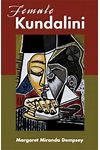
Sandwiched modestly amongst the heavyweights - the Red Book, the Biology of Kundalini, Climbing Days, Shamanism and Tantra in the Himalayas (what's that doing here? It's been around for years) - is Margaret Miranda Dempsey's volume 'Female Kundalini'. It is aptly named: Margaret is female, and she has experienced a kundalini awakening.
'Female Kundalini' I would not rate amongst the more remarkable volumes in my now-horizontal pile. It is, however, an enjoyable read. The first half is a potted life history, including details of Margaret's kundalini experiences. Westerners in whom the kundalini energy awakes do not appear to fit into any particular mould. However, my bits and pieces of research suggest certain qualities that are typical. Most characteristic is a strong and distinctive sense of the 'spiritual' - many people are what we could call 'seekers'. At the same time, they have a profoundly independent streak. They are not easily classified, and do not fit comfortably into spiritual groups. Outsiders, if you will.
In Margaret's case, she undertook study and practice of Mahayana Buddhism for many years with a group, while never feeling totally happy with such group. She eventually gained a reputation as a troublemaker, in the inconvenient habit of asking questions, and left the group to go to India and explore freestyle.
As a note: not all kundalified westerners fit this mould. There are those without any prior spiritual practice or obvious endeavour whatsoever. They may find things toughest of all.
The first part of the book, the life story, is a good read. It is the second half that is weaker. It consists of various of Margaret's reflections consequent to her kundalini activation. Some of it reads as a collection of thoughts that would not be out of place in many-a meditator's diary. I easily picture somebody sitting on top of a little hill, wide views below, sun going down, writing their thoughts for the day on a meditation retreat. It could easily be me, or you.
There is one incident, however, in the second part of the book that, for me, is a real standout. It makes the whole thing worthwhile.
Margaret attends a seminar in which the topic of honesty with regard to finances comes up. She sits smugly: I haven't stolen from anybody; I can just let this pass. Then, like a bolt out of the blue, it hits her. And she knows she has to act. No choice.
Her mind and her mum tell her she's crazy. But she has to do it. She is living in a different country now, and needs to travel abroad, returning to the place she lived twenty years beforehand. There she seeks out the shop that she worked in weekends as a student. Thankfully, it's still there, as is the man who employed her there in the first place. To his astonishment, she hands him a bag containing £300. 'You employed me twenty years ago. I used to give my impoverished student buddies money off when they bought stuff in here. I reckon it came to about £300.' This is the gist of what she says. And then she leaves.
As an interesting conclusion, she doesn't feel inspired and elated afterwards, as we might expect. She feels really crap: low and exhausted. But it's a fascinating story. A moment arrives when we simply have to do what we have to do, and normal logic doesn't play much of a role. Think you're in control of your life? Think again....
It's a little more than a year ago that I wrote a little piece about a kundalinified bus trip home. Nowadays things are less precarious; the journey passes pleasantly enough, and without incident. I stroll indoors and into the living room. There my eye falls with considerable satisfaction upon a little line of books at the bottom of a small table. For a long while, this collection had been an unruly pile of books, reaching higgledy-piggledy towards the ceiling. I don't do a lot of reading, but enough to produce a little pile from the volumes that I had bought and read over the past two years, starting with the dreaded 'Red Book'. These comprise my current literature, and I have been reluctant to hide the books away on bookshelves, where they will immediately acquire the status of 'historical document; job done', and will in all likelihood descend into oblivion, instant anonymity.Inconveniently, I was reminded at regular intervals that my pile of books did not win any prizes in the neatness-and-beauty stakes. Something needed to be done. Time and again I surveyed the living room, attempting to see where another bookshelf could be fitted in without cluttering the place up, or which books could be heartlessly relegated to the attic. Then, one day, it dawned on me. All I had to do was to pick up that higgledy-piggledy pile of books, turn it on its side, and it would magically become an elegant little row of volumes, a neat bookshelf lookalike. I knew all that right-brain stuff over the decades would come up trumps one day.
Sandwiched modestly amongst the heavyweights - the Red Book, the Biology of Kundalini, Climbing Days, Shamanism and Tantra in the Himalayas (what's that doing here? It's been around for years) - is Margaret Miranda Dempsey's volume 'Female Kundalini'. It is aptly named: Margaret is female, and she has experienced a kundalini awakening.
'Female Kundalini' I would not rate amongst the more remarkable volumes in my now-horizontal pile. It is, however, an enjoyable read. The first half is a potted life history, including details of Margaret's kundalini experiences. Westerners in whom the kundalini energy awakes do not appear to fit into any particular mould. However, my bits and pieces of research suggest certain qualities that are typical. Most characteristic is a strong and distinctive sense of the 'spiritual' - many people are what we could call 'seekers'. At the same time, they have a profoundly independent streak. They are not easily classified, and do not fit comfortably into spiritual groups. Outsiders, if you will.
In Margaret's case, she undertook study and practice of Mahayana Buddhism for many years with a group, while never feeling totally happy with such group. She eventually gained a reputation as a troublemaker, in the inconvenient habit of asking questions, and left the group to go to India and explore freestyle.
As a note: not all kundalified westerners fit this mould. There are those without any prior spiritual practice or obvious endeavour whatsoever. They may find things toughest of all.
The first part of the book, the life story, is a good read. It is the second half that is weaker. It consists of various of Margaret's reflections consequent to her kundalini activation. Some of it reads as a collection of thoughts that would not be out of place in many-a meditator's diary. I easily picture somebody sitting on top of a little hill, wide views below, sun going down, writing their thoughts for the day on a meditation retreat. It could easily be me, or you.
There is one incident, however, in the second part of the book that, for me, is a real standout. It makes the whole thing worthwhile.
Margaret attends a seminar in which the topic of honesty with regard to finances comes up. She sits smugly: I haven't stolen from anybody; I can just let this pass. Then, like a bolt out of the blue, it hits her. And she knows she has to act. No choice.
Her mind and her mum tell her she's crazy. But she has to do it. She is living in a different country now, and needs to travel abroad, returning to the place she lived twenty years beforehand. There she seeks out the shop that she worked in weekends as a student. Thankfully, it's still there, as is the man who employed her there in the first place. To his astonishment, she hands him a bag containing £300. 'You employed me twenty years ago. I used to give my impoverished student buddies money off when they bought stuff in here. I reckon it came to about £300.' This is the gist of what she says. And then she leaves.
As an interesting conclusion, she doesn't feel inspired and elated afterwards, as we might expect. She feels really crap: low and exhausted. But it's a fascinating story. A moment arrives when we simply have to do what we have to do, and normal logic doesn't play much of a role. Think you're in control of your life? Think again....
Sunday, 24 March 2019
Footnotes to Gnostics, Illuminati etc
Part One: Personal Appraisal
I think that in the previous post - Illuminati, Gnostics, and the rest - I went as far as I am capable of going at the moment, in one particular direction at least. I have been left with food for thought. For what it's worth ....
As far as 'social and political analysis, observation, comment' goes, there are far better people than me out there. Quicker on the uptake, more nimble of mind; more knowledgeable, more astute. Where I am pretty good, I feel, is on two fronts. Firstly, I can connect what is happening now with the longer game. As any lower league football team will tell you, there's a place for the long ball. Neil Kramer is good on this perspective, or used to be (I haven't kept up with him much in the past two years), and John Lash is brilliant in a hit-or-miss way. But many alternative commentators etc miss this necessary dimension completely. 'The longer game' is a question of maintaining a perspective, and of seeing everyday happenings as often small parts of far longer and deeper processes.
The other area is that of connecting 'today's news' with a metaphysical perspective - a spiritual or multidimensional perspective, if you like. Societies can be more or less inimical to self-realisation, and modern western ones are purposely antithetical to the individual, since the awakening of 'self', or 'Self', translates as the death of the Illuminati-slave patterning of human activities. A healthy society is one which recognises, permits, encourages, even, the supreme human endeavour. While in modern mainstream it doesn't get a look in.
This metaphysical perspective also involves not getting caught up in, and identified with, the menus and restricted dualisms presented to us as 'reality'. It is easy to do this: to end up seeing any situation through the lens of the constricting mainstream. Many 'alternative' commentators end up doing this to varying degrees. Even our good friend styxhexenhammer666 is not exempt. I like his style, his approach, his take on freedom, censorship, this type of essential stuff. But when I listened to him recently speaking about Maduro and Venezuela, he did roll out the 'socialism, bad; capitalism, good' banner. The metaphysical angle which I try to maintain here, avoids these simplistic either/or polarities. Socialism vs capitalism is a kind of false dichotomy, for one thing. And I don't want to play the 'good versus bad' game with topics like this. Socialism is often bad, I submit, as described in the previous post. However, the reality is more nuanced. Mel Fabregas is another presenter (again from the USA) who rolls this one out; understandably, since I believe he is from a family which braved the open sea to get from Cuba to USA. However, that Cubans and Venezuelans have undoubtedly suffered deprivations is not entirely the result of their socialist systems. Cuba is a nation that you could hardly expect to have been ultra-prosperous when most of the world was prohibited from trading with it, due to the bullying which has been characteristic of successive USA administrations.
The issue is not socialism/capitalism: it is the illuminati-style mindset, a phenomenon which exists outside and beyond any social or political configurations. This mindset can bend anything to its own nefarious ends, and is beholden to no particular social or political system. It is amoral in the very worst sense of the term. Communism: no problem. Liberal democracy: yes, I think we can use that. Socialism: yes. Capitalism: yes, yes. Socialism and capitalism are a ping-pong duality, which we can play until the end of time if we so wish. There has to be a third and 'higher' element which comes into play. Basically, what system you have is not primary: it's the consciousnesses of the beings involved. A 'better world' can happen only with the developing of wider consciousness, with the superseding of unconsciousness with self-determination and realisation. With the fostering and prioritising of individual magnificence. Which brings us nicely to....
Part Two: Kali Yuga
Yes. Back down on Maggie's farm, back in the good ol' Kali Yuga.....
It's the thing about the Kali Yuga. The bad guys always win. Once it was pointed out to me, it was so obvious, I had to laugh. I mean, it's self-defining: the Kali Yuga, the Age of Darkness, is by definition, that - the time when the bad guys win. That's what makes the Kali Yuga what it is.
And the good guys? Well, the good guys fight, stand up for all things of goodness and beauty, not in the hope or expectation of winning. They do it simply because it's what they do. They can't help it, they have no choice. It's part of what makes them good guys. They do it simply because it has to be done. It's an inner compulsion, even, we could say.
Brexit and the bad guys. The bad guys treat Brexit very seriously. For them, it's a battle lost, and in a Kali Yuga the bad guys aren't accustomed to losing any battles. They showed their true colours in their response to that referendum result. If they were people of honour, they would speak thus: "Well, we are sad to learn that you have voted to leave our lovely little club. You will be missed. However, we fully endorse the democratic process above all else, and shall endeavour to do everything we can to ensure a smooth departure. And to make things easy for the future, for everyone."
Needless to say, it hasn't been like this. Not that all the blame can be laid at the feet of folk outside the UK. Appointing a 'remain voter' to manage Brexit (ie Mrs May) has to be part of a pre-arranged stitch-up. Doesn't it? Before a crucial top-of-the-table football match between Manchester City and Liverpool, City aren't going to bring in the Liverpool manager, Mr Klopp, to mastermind their tactics and ultimate victory, are they? It seems as crass and ridiculous as that to me.
Trump, whatever you may think of him personally, is another battle lost. Not good for the globalist elite and their 'liberal' fan club. Not good, not good at all.
Having reread what I have written in this article thus far, I submit that it is rather dry and turgid! That's what you get for spending too much time and energy on those themes of illuminati worldview, conniving and manipulating against Brexit etc.
Strangely, martial language has begun to turn up in some recent blog pieces: wars, battles, fighting, winning and losing. Not generally characteristic at all. In terms of personal experience, Kundalini is predominantly a force which has evoked warmth, softness, fellow-feeling; feminine in an almost exaggerated way. More recently, however, it has woken up a very different type of energy. It has got into certain corners of consciousness, and activated a type of energy which feels adamantine, crystal-clear, hard and sharp. Warrior-like. In Tibetan Buddhist symbolism, the bell's ringing has aroused the dorje, the vajra. In Hinduism, read Shakti rising, where she eventually finds and embraces the awaiting Siva. It is Beauty kissing the sleeping Beast. Where there is Venus, there too must be found Mars, the martial language..
War Heroes
War heroes. War heroes? Well, I wish things were always as straightforward as that.... More like sacrificial lambs, sometimes. Brought needlessly to the slaughter in their thousands. In their millions.
Not so much heroes as utterly disposable pawns in someone else's dark and dirty game.
I originally intended to write a full piece on this. In the end, I haven't the heart, the stomach, to do it. I leave you to fill in the blanks yourself.
Take World War One, though. What was that about? Really? Some Bosnian Serb puts a bullet in the head of an archduke-to-be (who, by all accounts, nobody cares for very much anyhow) and before you can say 'Dig me a trench' half of Europe has been laid to waste. By the end of the four-year debacle, there are nine million combatant and seven million civilian deaths. Additionally, the political geography of the continent has been miraculously rearranged; coincidence, of course. No more Austro-Hungarian Empire. No more all sorts of stuff. No more Tsars in Russia, replaced for the benefit of all and modernity by Lenin's Bolsheviks. A new world was emerging, as a result of the sacrifices of our war heroes.
The trenches. Imagine the trenches. I'd rather not, and even with effort I find it difficult. What if it was all a bit, well, unnecessary. The official line fed to the lambs, sent bleating to their fate, their fate in the bloody trenches, wasn't quite true to what it was all about. A possibility that doesn't sit comfortably, does it? It certainly shouldn't do. So we had better not dig too deep; no knowing what we might find. Might all be a bit problematic....
Meanwhile, the heirs to that which remains unspoken sit smugly in their well-appointed offices in Brussels and elsewhere in Europe. The game - politely put, reorganising the political landscape of Europe still further - continues. To deny continuity between the tragic past and the dark, repressive present, is naïve at best. And the propaganda arm of the campaign, led in the UK by its state-sponsored broadcaster the BBC, is relentless and unremitting in its distorting, selecting, lying, omitting, in order to further the cause. If only more people knew the extent to which their minds are twisted and manipulated by the dirty little fingers of mainstream media, with the BBC at the helm. Scruple-free, morality-free.... Actually, some people may just prefer not to know.
That's all. As I write today I feel good. Yesterday, though, the whole thing was making me sick. And that is no good at all. If 'their' nefarious ways make you sick, then they have won. Then it's time to reframe oneself, as I did yesterday afternoon. On a hill, among the trees, the wind whispering in your ears. Life returned to its senses. Don't let the bastards get to you.
I think that in the previous post - Illuminati, Gnostics, and the rest - I went as far as I am capable of going at the moment, in one particular direction at least. I have been left with food for thought. For what it's worth ....
As far as 'social and political analysis, observation, comment' goes, there are far better people than me out there. Quicker on the uptake, more nimble of mind; more knowledgeable, more astute. Where I am pretty good, I feel, is on two fronts. Firstly, I can connect what is happening now with the longer game. As any lower league football team will tell you, there's a place for the long ball. Neil Kramer is good on this perspective, or used to be (I haven't kept up with him much in the past two years), and John Lash is brilliant in a hit-or-miss way. But many alternative commentators etc miss this necessary dimension completely. 'The longer game' is a question of maintaining a perspective, and of seeing everyday happenings as often small parts of far longer and deeper processes.
The other area is that of connecting 'today's news' with a metaphysical perspective - a spiritual or multidimensional perspective, if you like. Societies can be more or less inimical to self-realisation, and modern western ones are purposely antithetical to the individual, since the awakening of 'self', or 'Self', translates as the death of the Illuminati-slave patterning of human activities. A healthy society is one which recognises, permits, encourages, even, the supreme human endeavour. While in modern mainstream it doesn't get a look in.
This metaphysical perspective also involves not getting caught up in, and identified with, the menus and restricted dualisms presented to us as 'reality'. It is easy to do this: to end up seeing any situation through the lens of the constricting mainstream. Many 'alternative' commentators end up doing this to varying degrees. Even our good friend styxhexenhammer666 is not exempt. I like his style, his approach, his take on freedom, censorship, this type of essential stuff. But when I listened to him recently speaking about Maduro and Venezuela, he did roll out the 'socialism, bad; capitalism, good' banner. The metaphysical angle which I try to maintain here, avoids these simplistic either/or polarities. Socialism vs capitalism is a kind of false dichotomy, for one thing. And I don't want to play the 'good versus bad' game with topics like this. Socialism is often bad, I submit, as described in the previous post. However, the reality is more nuanced. Mel Fabregas is another presenter (again from the USA) who rolls this one out; understandably, since I believe he is from a family which braved the open sea to get from Cuba to USA. However, that Cubans and Venezuelans have undoubtedly suffered deprivations is not entirely the result of their socialist systems. Cuba is a nation that you could hardly expect to have been ultra-prosperous when most of the world was prohibited from trading with it, due to the bullying which has been characteristic of successive USA administrations.
The issue is not socialism/capitalism: it is the illuminati-style mindset, a phenomenon which exists outside and beyond any social or political configurations. This mindset can bend anything to its own nefarious ends, and is beholden to no particular social or political system. It is amoral in the very worst sense of the term. Communism: no problem. Liberal democracy: yes, I think we can use that. Socialism: yes. Capitalism: yes, yes. Socialism and capitalism are a ping-pong duality, which we can play until the end of time if we so wish. There has to be a third and 'higher' element which comes into play. Basically, what system you have is not primary: it's the consciousnesses of the beings involved. A 'better world' can happen only with the developing of wider consciousness, with the superseding of unconsciousness with self-determination and realisation. With the fostering and prioritising of individual magnificence. Which brings us nicely to....
Part Two: Kali Yuga
Yes. Back down on Maggie's farm, back in the good ol' Kali Yuga.....
It's the thing about the Kali Yuga. The bad guys always win. Once it was pointed out to me, it was so obvious, I had to laugh. I mean, it's self-defining: the Kali Yuga, the Age of Darkness, is by definition, that - the time when the bad guys win. That's what makes the Kali Yuga what it is.
And the good guys? Well, the good guys fight, stand up for all things of goodness and beauty, not in the hope or expectation of winning. They do it simply because it's what they do. They can't help it, they have no choice. It's part of what makes them good guys. They do it simply because it has to be done. It's an inner compulsion, even, we could say.
Brexit and the bad guys. The bad guys treat Brexit very seriously. For them, it's a battle lost, and in a Kali Yuga the bad guys aren't accustomed to losing any battles. They showed their true colours in their response to that referendum result. If they were people of honour, they would speak thus: "Well, we are sad to learn that you have voted to leave our lovely little club. You will be missed. However, we fully endorse the democratic process above all else, and shall endeavour to do everything we can to ensure a smooth departure. And to make things easy for the future, for everyone."
Needless to say, it hasn't been like this. Not that all the blame can be laid at the feet of folk outside the UK. Appointing a 'remain voter' to manage Brexit (ie Mrs May) has to be part of a pre-arranged stitch-up. Doesn't it? Before a crucial top-of-the-table football match between Manchester City and Liverpool, City aren't going to bring in the Liverpool manager, Mr Klopp, to mastermind their tactics and ultimate victory, are they? It seems as crass and ridiculous as that to me.
Trump, whatever you may think of him personally, is another battle lost. Not good for the globalist elite and their 'liberal' fan club. Not good, not good at all.
Having reread what I have written in this article thus far, I submit that it is rather dry and turgid! That's what you get for spending too much time and energy on those themes of illuminati worldview, conniving and manipulating against Brexit etc.
Strangely, martial language has begun to turn up in some recent blog pieces: wars, battles, fighting, winning and losing. Not generally characteristic at all. In terms of personal experience, Kundalini is predominantly a force which has evoked warmth, softness, fellow-feeling; feminine in an almost exaggerated way. More recently, however, it has woken up a very different type of energy. It has got into certain corners of consciousness, and activated a type of energy which feels adamantine, crystal-clear, hard and sharp. Warrior-like. In Tibetan Buddhist symbolism, the bell's ringing has aroused the dorje, the vajra. In Hinduism, read Shakti rising, where she eventually finds and embraces the awaiting Siva. It is Beauty kissing the sleeping Beast. Where there is Venus, there too must be found Mars, the martial language..
War Heroes
War heroes. War heroes? Well, I wish things were always as straightforward as that.... More like sacrificial lambs, sometimes. Brought needlessly to the slaughter in their thousands. In their millions.
Not so much heroes as utterly disposable pawns in someone else's dark and dirty game.
I originally intended to write a full piece on this. In the end, I haven't the heart, the stomach, to do it. I leave you to fill in the blanks yourself.
Take World War One, though. What was that about? Really? Some Bosnian Serb puts a bullet in the head of an archduke-to-be (who, by all accounts, nobody cares for very much anyhow) and before you can say 'Dig me a trench' half of Europe has been laid to waste. By the end of the four-year debacle, there are nine million combatant and seven million civilian deaths. Additionally, the political geography of the continent has been miraculously rearranged; coincidence, of course. No more Austro-Hungarian Empire. No more all sorts of stuff. No more Tsars in Russia, replaced for the benefit of all and modernity by Lenin's Bolsheviks. A new world was emerging, as a result of the sacrifices of our war heroes.
The trenches. Imagine the trenches. I'd rather not, and even with effort I find it difficult. What if it was all a bit, well, unnecessary. The official line fed to the lambs, sent bleating to their fate, their fate in the bloody trenches, wasn't quite true to what it was all about. A possibility that doesn't sit comfortably, does it? It certainly shouldn't do. So we had better not dig too deep; no knowing what we might find. Might all be a bit problematic....
Meanwhile, the heirs to that which remains unspoken sit smugly in their well-appointed offices in Brussels and elsewhere in Europe. The game - politely put, reorganising the political landscape of Europe still further - continues. To deny continuity between the tragic past and the dark, repressive present, is naïve at best. And the propaganda arm of the campaign, led in the UK by its state-sponsored broadcaster the BBC, is relentless and unremitting in its distorting, selecting, lying, omitting, in order to further the cause. If only more people knew the extent to which their minds are twisted and manipulated by the dirty little fingers of mainstream media, with the BBC at the helm. Scruple-free, morality-free.... Actually, some people may just prefer not to know.
That's all. As I write today I feel good. Yesterday, though, the whole thing was making me sick. And that is no good at all. If 'their' nefarious ways make you sick, then they have won. Then it's time to reframe oneself, as I did yesterday afternoon. On a hill, among the trees, the wind whispering in your ears. Life returned to its senses. Don't let the bastards get to you.
Subscribe to:
Posts (Atom)