Welcome into the vortex........

anarcho-shamanism, mountain spirits; sacred wilderness, sacred sites, sacred everything; psychonautics, entheogens, pushing the envelope of consciousness; dominator culture and undermining its activities; Jung, Hillman, archetypes; Buddhism, multidimensional realities, and the ever-present satori at the centre of the brain; a few cosmic laughs; and much much more....


all delivered from the beautiful Highlands of Scotland!


Friday, 27 May 2016

Parapolitics: The Clincher

One of the more paradoxical consequences of my former involvement with organised Buddhism is that it initiated an introduction to, and real interest in, the arts of western culture. The best of art was apparently suffused with spiritual qualities, and could form a significant practice for those wishing to develop wisdom, compassion, and the rest. I am grateful for this initiation into the arts, especially some classical music and the Italian Renaissance painters.

My Buddhist teacher had a certain enthusiasm for the writings of Samuel - 'Doctor' - Johnson, even running a short seminar on a couple of his poems, to which I was invited, and which I duly attended. I never found Johnson much of a turn-on: I envisaged him as one in a line of British travelling curmudgeons, more recent examples being Alfred 'The Lake District' Wainwright and Cameron McNeish. This might have been extremely uncharitable on my part, but there we have it.....

One of Johnson's quotations that sometimes popped up within my world of organised Buddhism concerned second marriages. Getting married once, the Great Sage opined, is understandable. But doing it a second time was foolish in the extreme. It was, he stated, 'the triumph of hope over experience'. In a Buddhist organisation which followed the general pattern, with a tendency to idealise celibacy while gently (or not) disapproving of sexual relationships, Dr Johnson was quoted with a knowing nod of the head. Rock on, Sammie babe, what a shit-hot dude you are, was the general sentiment (though not necessarily expressed in those words exactly).

I was never overly impressed with Johnson's words of marital wisdom. In fact I find them a bit silly. Still, let's go with this a while...... 'the triumph of hope over experience'. Where will it lead us?

Sadly, I found some of these same Buddhists who quoted Johnson with a hearty guffaw less able to apply this notion to other areas of life. It was, I suppose, pretty safe and easy to give a thumbs-up to Johnson when he confirmed ones own pseudo-spiritual dispositions. Yet when 'hope over experience' could be presented to shed light on less comfortable aspects of life, which might indeed require turning the whole thing upside down, it might be better to turn a blind eye.

These were the thoughts that appeared a few weeks back, as I strolled down the Inverness High
Street. It was a week or so before some election or other, and the lamp-posts hung heavy with posters and placards declaring the various parties and some of the candidates. Lib-Dem, UKIP, Tory; Labour, SNP, Green; Scottish Christian Party. I know nothing of his policies - probably what we might expect - but the Conservative had the best name: one Edward Mountain. I looked out for Lucinda Lochan and Peter Precipice, but they were nowhere to be seen.

I was puzzled, confused, by the whole show. For one thing, it hadn't registered that there was an election of any description on. But the question loomed large: do people still believe in this stuff? Ten years ago, when I began work along this very  High Street, it was precisely the same. The same tired placards, the same weary attempt to elicit support. Mr Mountain was probably not there a decade ago, but otherwise nothing had changed.

I can kind-of understand a twenty-year old getting involved with this stuff. Youthful, idealistic, experimenting with the ways of the world. But older folk, with a decent beltload of experience wrapped around their by-now protruding bellies? How have they failed to learn? To not see, after decades of unfulfilled promise, shattered expectations, falsely-placed optimism? Nothing has changed. A few details, yes, but viscerally no. This is the real spectacle of hope triumphing over experience.

It requires a fundamental shift in consciousness, one that may be unsettling, disturbing; it may throw your entire view of life and who you are into turmoil. Which is why, I suppose, so many people don't go there. To see that the story of progress, of change, - of hope - is a phantom paraded before our eyes as a deception, a chimera intended to keep us quiet, content in our discontent. To maintain our status, without our even knowing, as sheeple, as some would unkindly have it. The road ahead is not in reality a road at all. It is a hamster wheel. There will be no change on that wheel. It is not intended to change, not designed to change. It simply keeps the system of hierarchy, of control, running smoothly. That is its function.

How many times do folk need their hopes dashed before they 'get it'? To see those moments of historic hope - the Blairs, the Clintons, the Obamas - come to nothing. Of course they come to nothing: that is the point. I have been there - I know. I was one of the multitudes who shed a tear to see Tony Blair out shaking the hands of the people on his first day in office. Gone the terrors of Thatcher and her inept successors. In with the righteous. But within a couple of years, Blair was clearly manifesting as a monster even more terrible than anything Thatcher and her buddies could dream up. These experiences form the node of learning, of going deeper into the fabric, burrowing down into what is really happening.

The torch-bearers of hope are in fact necessary for the continued survival of our broken system. Precisely because of that: they wear the raiment of hope, the promise of better things to come. Without them, the system will surely implode entirely with its own fatigued decadence, its monolithic cliches uttered by puppets almost too world-weary to open their mouths and speak. British politics a few years ago - especially English politics - defined by the pathetic, moronic personages of Cameron, Miliband, and Clegg. A system on the verge of grinding to a complete halt though lack of energy. The system needs its 'hopes' to provide a necessary injection of vitality, of energy. Regardless of their political persuasions, these folk - the Trumps, Farages, Corbyns - are essential, to provide engine fodder. They are viciously, shamelessly, and relentlessly attacked by the mainstream media - I find it a spectacle horrible to watch. Surely, though, a vote for Hillary is a vote with a death-wish: a vote made in glaring blindness, a vote for the system as it rolls out its rubbish over the decades, over the centuries. Well-intentioned people all-too easily rolled over, voting for control, limitation, the death of independent, intelligent thought and being. This is the way: bring out the mavericks, providing a sense of hope for the masses; just don't let them go too far......

In the meantime, let us go forth, with experience our teacher, experience our guide. Do we need this version of 'hope' at all?

Images: Illusion of change: surface waters in motion, while the creatures of the deep continue life regardless. The Skye Cuillin, off Elgol.
             The Star, from Phantomwise Tarot.


Wednesday, 18 May 2016

My Buddhist Inventory: the other bits

I have written about the bits of my decades in organised Buddhism that I found really helpful; I have written about some of the aspects I found to be a nest of vipers. There remain the bits that, while not exactly harmful, didn't quite come up to what it claims on the tin. A cursory trip around the personal universe uncovers three subjects that immediately present themselves.

First up, Buddhist ethics. Like all forms of organised spirituality or religiosity, Buddhism comes with
a ready-made package of behavioural do's and don'ts. True to form, it is softer than its monotheistic equivalents, presenting precepts or guidelines, rather than rules and commandments (this is not strictly true, since you can get chucked out of monkhood for breaking certain precepts, I believe - and if that ain't rules and regs, I don't know what is). Nevertheless, the main approach is providing guidelines: this is how an enlightened being would behave naturally, the theory goes, so by adopting these styles, you will draw closer to Buddhahood.

That's all OK, I suppose. But I don't think, in general terms at least, I needed the ethics of Buddhism. I was already a reasonably decent person with an instinctive behavioural code in place before I came across organised Buddhism. Buddhism could theorise more comprehensively than me about why sila (the Sanskrit for morality) should be practiced, but I can't say this impinged upon my being very much. The practice of ethics Buddhist-style did not bring me much closer to Buddha. In fact, the main effect of taking Buddhist ethical proscription seriously was that it made the area of sexuality even more complicated and precarious than it already was.

Second, I've got study. We did plenty of studying of various Buddhist texts, along with a smattering of other books and poems that were reckoned to shed light upon the path towards Enlightenment. In my earlier days of Buddhism, in particular, we also spent many hours listening to lectures recorded on tape delivered by our teacher, explaining and amplifying on a wide range of Buddhist and Buddhist-related topics.

A few things stand out, moments that really jolted me. One such was my teacher's seminar on the 'Greater Mandala of Aesthetic Appreciation', or uselessness. The world does not exist primarily to be used: it is there to be appreciated, enjoyed for what it is. It is as it is. This is Wisdom, a profound non-utilitarianism. This I found most revealing and it speaks bucketloads to me to this day. Buddhism is often pretty good on conceptual clarity (one of its attributes that initially attracted me), and some of its concepts remain helpful in giving voice and shape to felt experience.

However, the majority of study that I undertook, including that which I 'led', sometimes laughably, had very little impact on me, my current depth-charge of honesty reveals. An awful lot failed to speak to me. At best there was some exercise of the intellectual faculty. But quite a lot was high on the scale of tedium. At worst, it was confusing, frustrating, enraging.

I recall one seminar held by my former teacher. I should express gratitude for being invited, but I suspect my invitation was based largely on my being local friendly bigwig at the time. It was on a book called 'Forest Monks of Sri Lanka'. Though in some respects a maverick, my teacher was always keen to find validation for his particular approach within the wider Buddhist tradition, and to find parallels therein. There were apparently echoes of our own style within the activities of these Forest Monks. We students would read a chapter in the morning, then convene in groups to come up with earnest intelligent questions to fire at our teacher during the evening session. This really was one of the most tedious little periods of my life to date. I had as much in common with these Forest Monks of Sri Lanka as I did with alien invaders from some outer galaxy. After a number of days of fruitless head scratching, I eventually came up with a question that I found interesting. It was about inner fire or something, a footnote to the main meat of the seminar, about lifestyles and organisation among the Forest Monks. 'I have dealt with this subject in another seminar' was my teacher's curt reply to my futile attempt at personal engagement. 'Next question please.'

I recently engaged in a full-scale scramble around in dusty boxes in the garage to see if my copy of this noble tome was still around. Nowhere to be seen. In a fit of blasphemy, I must have chucked it out somewhere along the line. I was mortified. I had checked it on Amazon, and copies are nowadays worth a pretty penny.

The final bit (for now, at any rate) that current reflection suggests was not personally up to what it was supposed to be concerns work. The particular Buddhist organisation I participated in was big on work - in the 1970s and 1980s especially, when my involvement was at its height. The rationale was well-formed. Work got your energies going. Work for the organisation (which is what we are mainly talking about here) was a positive action, helping other people to get going on the Buddhist path, and helping to create a better society. Work involved co-operating with others, learning to communicate creatively. Work was, in sum, the Boddhisatva spirit in operation. You couldn't ask for more than that, could you?

Working with like-minded people; helping to create a better world: this was what my pre-Buddhist life had been about, when I lived in a commune. I should have been in paradise. But I often wasn't....

When I first moved to London to practice Buddhism, my mind was very clear. I was going to find a part-time job, earning enough for survival, then devote the remainder of my time and energy to meditating and studying the Buddhist texts. I was up for Enlightenment, and this was the way to go about it, I had concluded. Some people thought otherwise. A short time after moving into Buddhist community in Archway, north London, I was approached by one of my fellow community members and new-found buddies. He had just started a wholefood business, selling healthy foodstuffs on market stalls and with a basement stockroom away in east London beneath the 'under construction' big new Buddhist centre over there. Did I want to go and have a look? I said 'yes'; and the rest, as they say, is history. Before I knew it, most of my waking hours were being spent packing peanuts into bags and plying our health-giving wares in Brick Lane and other London markets at weekends. I was so good at this work stuff that, as related in a previous post, within three years I was chairing the West London Buddhist Centre.

Why, when I look back, does it seem (not in black and white, but on balance) so unsatisfying? I was living the dream, wasn't I? Some of the 'work is good' rhetoric didn't wash: 'getting my energies going through work' was one. I had come into Buddhism fresh out of fifty- and sixty-hour weeks in warehouses and delivering mail during my commune days. The vital difference was that, during that phase, I was putting into practice a dream that came from (or flowed through) me. It was personal and universal in equal measure. Now, it seems, I had signed onto someone else's dream. I wanted to do Buddhism, but how to go about it was being dictated to me by others who, I was informed, were more 'experienced' and knew better. I learnt the art of giving people the benefit of the doubt, a pernicious mindset to fall into. It was no longer my dream; I had given it all away - or a good dose of it, anyway.

That moment when I allowed myself to be diverted from my path into the 'building a Buddhist movement' was critical. That is the seminal snapshot of experience which I feel is the precise node of personal growth for the future. I don't want my 'soul' to have to go down that route again; the route of 'giving it away' in the mistaken belief that I 'getting it'. What do I require to ignite within the core of my being to avoid the endless repetition that accompanies lessons unlearnt? The answer, it has been emerging of late, is simple, though hard to practice. It is simply a matter of connection to the path. Stay connected and things cannot go far off-course. Remain true to heart and instinct; engage with others fully, intensively, but don't give your dream away.

It was balm to my soul, and a sure sign that I was on track, when I emerged from organised Buddhism and began to discover folk like Neil Kramer, uncompromisingly emphasising personal uniqueness and authenticity, listening to the voices within, finding your own way on the sacred path.

I find it fascinating that all three 'not very useful practices' I have described here are employed in distorted form by the perpetrators of darkness in our world as means of control. 'Ethics', codes of morality, can become ways to make people afraid, submissive, easily manipulated. The notion of 'Study' can be distorted into ideology, belief systems and media brainwashing. Work can be used as a means of exploitation, keeping people in the state of slavery to a heartless system for all their lives. There are always these tendencies, subtle though they may be.

In the end, the Buddhist trip was just getting in the way. What started off as a passport to liberation became a yolk around the neck. I feel that I was offered a very basic, 'exoteric' path, which led so far and then hit a brick wall. My sense of the magical, the mystical, the multidimensional magnificence of living was left unassuaged. Some of my Buddhist friends and former colleagues have attempted a resolution by going Tibetan, but the complex system of grades of initiation, ritual etc isn't for me. Others have gone into focussed non-duality, no-self stuff. In my view, this has its not-inconsiderable value, but leaves me wanting for the truly mystical, noumenous way. It is one part of the jigsaw only. In the meantime, I feel that I have come back home.

Let's finish with Acharya S., one of the voices of inspiration, courage, and uncommon common sense that has spoken to me out of the jungle of nonsense. "To truly 'get' Buddhism, one needs to become a Buddha, and a Buddha is a free agent not belonging to any particular group, cult, or religion, not separate from 'God', and not ascribing to ritual and rote, except that which moves her/him in her/his autonomy." (In 'Is Buddhism all it's cracked up to be?'). Thanks, Acharya.

Images:

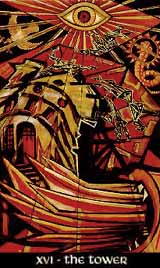
The Tower, Thoth Tarot. The terrifying magnificence of collapse. for example of preconceptions about reality. The destructive aspect of change.

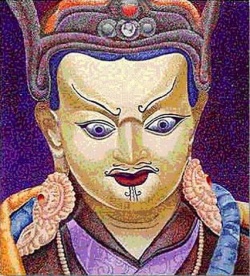
Guru Rinpoche Padmasambhava. The all-penetrating eye that seeks out every tiny speck of bullshit. Courtesy of ChinaBuddhismEncyclopedia.


Thursday, 12 May 2016

Always the Fool

'Organised Buddhism' is the term that I seem to have settled on to describe the phenomenon that I am in the process of exploring right now. It is 'organised', not to distinguish it from 'disorganised Buddhism' or the like. No. It is to suggest how Buddhist practice in this case comes within a framework of a collectivity with agreed principles, practices, approaches, and the rest. My purpose in this writing is not to give anybody a hard time, or to apportion 'blame'. It is to examine my own life, where it has gone and why; and what lessons can be learnt from all this, so they are not repeated. When I turn to the phenomenon of 'organised Buddhism' it is instructive to see how the original naked pure motivation of liberation of the individual can - and often does - so easily become subsumed under an umbrella of collectivity, with its norms, rules or guidelines, its 'this is the way to do things and not to do things'. How the collectivity insidiously takes on its own identity, with survival and aggrandisement as priority over everything else; its promotion of its own goodness, excellence, uniqueness.

In 'The Buddhist Inventory', April 28th, I illustrated the theme with the Hierophant, Tarot card number five, from the Rider-Waite deck as embodying the essence of organised religion, organised spirituality even. The Hierophant manifests orthodoxy, conformity, the established order, tradition in a sense. So much so that the card is sometimes referred to as the Pope.

I have a problem with the Hierophant: this is one way of looking at the some of the underlying themes of these pieces. A wander around the internet quickly showed me that I am not the only person with Hierophant issues. Nevertheless, there it is, a card in the Tarot, one aspect of the totality of experience to be undergone on the sacred path, should we read the Tarot in this way. In order to shed more light on the Hierophant, I decided to check out a different version, that from the Thoth Tarot deck of Aleister Crowley. Good old Aleister,always to the rescue! The Thoth deck is fascinating, as we might expect from a Tarot originating in the uneven wisdom of the Great Beast, and doesn't shy from the darker sides of reality. It is the Hierophant of the Thoth Tarot below.    


A short but illuminating commentary on the Thoth Hierophant by Suzanne Wagner, readily accessible on Youtube, points up several salient details of Crowley's depiction. One is that around the head of the Hierophant, behind which can be seen a stained-glass window, is a dead snake. The serpent, as we know, is a manifestation of both sexual and spiritual energies. And in the case of the Hierophant, it's dead, stuck through with daggers. And standing beneath the Hierophant is the Egyptian goddess Isis. Her left hand holds a waning moon: the moon, filled with the energy of the sacred feminine, dwindles under the influence of formal religiosity, of the conventional and conformity. Organised religion, be it Christian, Buddhist, or other, will by its very nature have an uneasy relationship with the feminine, regarding it with suspicion at the least, or attempting to destroy it completely. The Thoth Tarot has the Hierophant's number.

Our true nature, in both its being and its becoming, is perfectly expressed in another figure from the Tarot, the Fool (Rider-Waite Fool shown at the beginning of this piece). The Fool, significantly, does not possess a number: he is zero, out of time, or present everywhere. He kind-of stands at the beginning of the Great Journey, and kind-of stands at the end. If we do the trip right, he is our companion every step of the way. And this, I have discovered, was my error, as I immersed my being more and more in organised spiritual life. I lost my prime identity, my visceral affiliation with the Fool. Or, I didn't lose it, but entered a state of amnesia. In the reality that is Tarot, the glorious Fool heads off on a marvellous adventure, the morning sun on his back. He travels light, with just a few necessary provisions wrapped in the kerchief he carries on a stick over his shoulder. His folly is that he walks with his head in the clouds, heedless of the precipice he is about to fall off - into disaster or freedom, nobody knows. The dog at his heels tries to alert him to the earth beneath his feet, to watch where he walks. Naive yet magnificently wise, the Fool treads his journey of life free - nobody could be further from the vice of organised religion than he.

To repeat what I said above: the problem with organised Buddhism, as with organised anything else, is that it becomes concerned with its own identity, and its own perpetuity, its survival through time. It takes itself too seriously, believes in itself in the wrong way. It is this unspoken agenda that fuels the rigidity, the standards, the do-it-like-this-or-you're-out. My former Buddhist teacher has become preoccupied, it would seem to me, with the preservation of his writings above all else, as a means of continued influence on the world of western Buddhism. He could, instead, trust in the divine and in the integrity of his disciples, and wander free like the Fool. But his chosen priorities are typical, I suggest, of the syndrome I am outlining here.

Were I to take on the mantle of the Hierophant and set up my own religious or spiritual organisation (heaven forbid), I would do it as an ongoing apprenticeship. Every three years, say, the disciple would go out into the wilderness for a fortnight to consider. With no prejudice, no holds barred, they would view their life, their current reality, and ask the question: do I wish to continue beneath this spiritual umbrella, or am I ready to go forth in all my glorious unique authenticity, taking and giving freely whenever and wherever seems fit? Can I walk the face of this magnificent Earth, my home, with the self-knowledge to penetrate its greatest mysteries, live fully its adamantine miracle, its eternal present? If so, I am free to go, with the deepest blessings of all I have struggled and loved and practiced with. It is The Way.

There is more that I wish to write on this theme. But I set out with a central question: how did I falter on my own way, and what lesson can be learned to avoid this repeating itself? In my writing, I have stumbled upon at least some of the answer.
        

Thursday, 5 May 2016

My Buddhist Inventory - some nasty bits

It's high summer 1987.... 88? Does it matter? By dint of a miracle conferred by some supernatural entity or other, I have been chairman (nowadays chairperson) of the modestly-titled West London Buddhist Centre for some eight years or so. I am generally friendly (-ish) and approachable, and my sense of responsibilty means that the meditation classes start on time. In other respects, however, I am gloriously unsuited to the job. Expansion is the name of the game, with the goal of ever-more people flocking to an increasingly-full weekly programme of beginners meditation, yoga and massage classes, study groups, meditation for experienced people..... you get the picture. This is not a world that I readily fit into. At our summit meetings, other chairmen try to remain patient as the West London Buddhist Centre still shows no sign of getting much bigger. I seem to be pathologically lacking in the crusading spirit. Don't I realise how important spreading the word is?

I have finally had enough, and announce as much to my fellow workers in West London. They are generally supportive: a reluctant leader is a rubbish leader, after all. It remains to communicate with the head of the Buddhist Order and organisation with which I am intimately associated. He is away somewhere or other, but I write a letter. Informing him of our collective intention, I end by saying that, if I hear nothing from him, I will assume his assent. End of story; or so I think.

I soon receive a reply, along with a summons to his residence in deepest Norfolk. This 'I shall go ahead if I hear nothing' approach is not, it appears, good form. I turn up with a day return train ticket in my pocket and a heavy bagload of apprehension. The head of the Order does not consider my idea a good one at all. There are, I am informed, no suitable replacements for me as yet; I should stay on for another couple of years while a successor is found and duly trained up. And that is it. There is, as I recall, no question about how I am feeling personally, why I wish to relinquish this role, what I might like to do with my life instead of running the Buddhist centre, and how any personal difficulties I may be having could be constructively worked with. No. My individual whims and fancies are, it appears, irrelevant. There is a Buddhist movement to be run; that is the main thing. And I am in the service (at the mercy, more like) of the Greater Good.

I was once proud to be a shit-hot ultra-transcendental psychedelic countercultural superhero. In the space of ten years I had managed to evolve and develop to..... this. A piece on the chessboard of Buddhist empire-building. That's not all I was, but a piece all the same. I did not see it clearly at the time, of course. Maybe it was a jolly good empire, with a unique and vital message for the world. Nevertheless, from that moment on, there was one direction, and one direction only, for me to take. And that was 'out'.

To their great credit, some of my fellow Buddhist workers in London were far from happy with my intention to remain for those two years. They were personal friends, and knew that I was frustrated. They stuck to their 'a reluctant leader is a rubbish leader' guns. However, I decided to stay. I had read my Tibetan Buddhism, and knew about the flaming hells that await people who go against the guru. So it was that I signed myself up to the most frustrating two years of my life to date. I mean, what do you do?

This story encapsulates the essence of the messy side to my years as full-on Buddhist. I jumped in with the dream of discovering my own true nature, but ended up giving plenty of it away. It was all, fortunately we might say, soft core in the particular organisation I became affiliated with. I was not easy meat for the more extreme total and totalitarian cults of fervent devotion that were floating around at the time. I was not readily taken in by swamis, gurus, perfect ones, and the rest - my anarchistic, commune past led me to view leaders and authorities, even enlightened ones illuminating the way to the promised land, with circumspection.

The head of the Order I eventually joined would style himself as teacher rather than guru, in an attempt to distance himself from the intelligence-numbing excesses of some of the characters turning up with their roots somewhere in the orient. There was, in many respects, a good deal of leeway in the movement that he set up. The notion of 'becoming a true individual' was held in high esteem, though in an increasingly uneasy dynamic with 'following the Buddhist path within a specific context'. A distinction was made between a 'group' and a 'spiritual community', the latter consisting of a collection of aspiring individuals, rather than a bundle of sheep. Good theory, but life ain't quite as simple as that. And when you've got a movement to run, classes to teach, Buddhist businesses to service ......

As mentioned in my previous article, the high value placed upon friendship was, in my view, one of the good things about this particular Buddhist organisation. There was, however, a dark side to this 'getting to know people' lark. Especially if you were promoted to being one of the people in high places, you would suddenly find yourself in demand. Everybody wanted to spend time with you, be friends with you. Conversely, it became one of your own duties to spend time with people - regardless of whether you liked, wanted to spend time or be friends with this particular person. The business lunch was replaced by the spiritual lunch, and walking-and-talking in the park, or countryside lanes if on retreat, became the order of the day. It was part of our culture, really. People wanted to learn from you, be inspired by you, even if you felt crap, hadn't a clue what you were doing, and the problem being placed in front of your nose was way outside your personal experience.

Most insidious, and something that to this day I feel shame about, was the twist: walking and talking, chomping pasta together, invariably contained a subtext. Getting people more involved. Different levels of involvement existed, based upon the individual's degree of commitment to our particular brand of Buddhist practice. Especially with folk who were 'beginning to get more involved', this hidden - or not so hidden - plot would be there. People would sense this, and it was not to everybody's taste. I still recall a number of very decent interesting people I knew, who 'disappeared' after one subtle 'involvement' lunch too many. I wish here and now to, in the Buddhist lingo, confess my faults, and say sorry to those who may have been put off by this. Why wasn't it good enough to simply experience the pure joy of being with another human being, free of agendas? Why not? Oh, I forgot. What we were doing was so great that any reasonable-minded person would want to jump in. And it was good to have expanding classes, bigger businesses etc.

Then there was the opposite. While those people who didn't want to get more involved were diagnosed as 'having a problem', there were others who wanted to get more involved, but were deemed not as yet ready. Then lunch would involve indigestion, as you tried to explain that they didn't have enough self-confidence, or they had too much, or were just a bloody mess. Sorry, guys, sorry.

It was a funny thing, really. To jump into something that really seemed like a ticket to total freedom, then gradually sense that liberation was no longer taking place, personally (and I speak 'personally' here) at least. That the bus pass came with a bundle of conditions and restrictions, 'valid on these routes only', that seemed conducive to anything but freedom.

So this is a snapshot of some of the 'nasty bits'. There remain for another time the bits that just didn't seem to work.......

Image: Ulmata Mahakala/Bhairab. Destroying delusion in whatever form it may manifest.


Thursday, 28 April 2016

The Buddhist Inventory

This month marks the fortieth anniversary of my first proper contact with organised Buddhism on a weekend retreat. Also approaching is the ten-year mark of my formal departure from aforementioned organised Buddhism.

In recent months I have been writing, off blog, about the period of my life prior to my engagement with organised Buddhism. This time, involving full-on commune living, 60-hour working weeks sorting and delivering mail in Oxford, free festivals and psychedelics, is one that I hold with great fondness in my mind. I had felt the urge to write about it for some while, but had demurred, as thoughts about hanging on to the past, wasting your short precious human life on things that have been and gone, made rapid orbits around my mind. Then, one day, I decided to drop all this theoretical objection stuff, and just do it. Write, and see what happens, rather than indulging that old bad habit of over-thinking, attempting to chart the voyage and understand the further shore before you've set sail.

One thing to come out of this: despite the confusion and the hard times, the psychedelic commune period in my life is one that I recall vividly, and with a high degree of personal affection and satisfaction. It is the Buddhist full immersion project that manifests as more problematic. Considerable periods of it are little more than a fug and a fog. This is all, on the face of it, a bit strange.

I intend to write a number of pieces based around this theme of immersion in organised Buddhism ('organised Buddhism' seems to be the phrase that I have settled for; why may become clearer in due course), partly for personal benefit, and partly because it throws up issues of more general concern regarding how to live a spiritual or creative or authentic or mystical or whatever life. Personally, I know that there are lessons for my soul to learn - and to me it's important that those lessons are learnt.

The personal Buddhist period divides neatly into three sections of roughly similar length, a little under a decade each. Phase One: full-on immersion, characterised by enthusiasm overall. Phase Two; serious questions come to the fore, and inspiration is increasingly sought elsewhere; Phase Three; steady withdrawal, to the point of official resignation.

The process of leaving was gentle, slow, almost unnoticeable. Involving, as it did, a remoulding of my conscious identity - who am I? - it had to be treated with utmost seriousness. I succeeded in leaving the Buddhist Order fairly free from those feelings of bitterness, anger, and rancour, that sometimes characterise such a change. The majority of my friends with whom I can share openness are from my Buddhist days, though some have, like me, renounced that Buddhist organisation, while others again are still there having come to their own arrangement of how to survive within that particular context.
  

A good way to begin this investigation might be with an inventory. I came across the notion of the inventory in relation to some of Carlos Castaneda's work. In 'Journey to Ixtlan', Don Juan advises Carlos, the eternal fall guy, to 'erase personal history'. This is a topic that I have returned to over the decades many times. What does it mean? And how do you do it? It is not, if I understand properly, a question of literally forgetting everything that ever happened in your life. But it is a matter of personal detachment, if you will; of freeing oneself from the emotional and energetic traces, blocks, left by what you have done in the past. Removing the sense of 'personal' from the equation. Disentangle, de-identify. Do this and energy flows freely.

Castaneda offers no techniques as such, but a number of his followers do. You engage in the recapitulation; you recapitulate your life. Every little bit of it. In order to do this, you first draw up an inventory of your life. Different folk provide variations on the precise details of how to achieve this - but the central idea is to write down all the people you have ever known, and all the events that you recall happening with them. Then, following a specific technique, you recapitulate the lot, not just remembering but, with the aid of the particular practices, actually reliving and thereby becoming free from the tangles, the binds, the complexes constricting your energy.

I have not attempted the recapitulation. It is a gargantuan task, methinks. However, just holding the idea in your mind seems to have a certain effect. I shall, nevertheless, present a brief and partial inventory of 'my life in organised Buddhism'. The good bits and the bad bits. So here goes.....

There were several great boons from this period in my life. Firstly, organised Buddhism provided a safe haven, a supportive environment, at a time when I most needed it. It was 1976, and I hit the beginning of that year inspired and confused in equal measure. The spiritual life was calling loud but not so clear. The commune project I had been involved in was falling apart, and so was I. Following a couple of years of LSD-assisted epiphanies, I felt I needed to steer a steadier course, as more psychedelic multidimensional experiences only served to create more chaos.

There were two great things about Buddhism. In brutal contrast to the belief and ideology-based style of orthodox Christianity, Buddhism adopted an eye-opening suck-it-and-see approach. There was no need to believe in all sorts of random unverifiable stuff; just try it out and see what happens. What a relief! And what happened was that meditation worked. A practical tool, it enabled consciousness transformation. Brilliant. I knew this, not because it said so in any silly book, but because I experienced it directly.

The other longed-for thing that Buddhism provided was apparent clarity. It had all sorts of things you could do, and all kind of maps intended to help you navigate through the muck and mire of conditioned existence. The Eightfold Path, the Threefold Way. The Four Noble truths, the Six Paramitas. It was like spiritual satnav. Sit back, follow the routemap, and bang, there you are, enlightened. It was Apollonian, a boon to this young aspirant who showed symptoms of Dionysian overkill. And nobody else - Hindus of different shapes and sizes, Taoists (you couldn't find them anyway), psycho-this or psycho-that people - had anything to match Buddhism's user-friendly maps and manuals. Just what was needed.

The second great personal boon concerned friendship. Unlike many other Buddhist groups and organisations, the one I was part of was big on friendship. It was viewed as focal to spiritual life. It's funny really. There is a multitude of fellow Buddhists who I worked and lived with over the years. Despite our being apparently kindred spirits, having committed our lives to the same goals, and despite living together, working together, meditating every day together, breathing the same air together. Despite all this, in the majority of cases, once the living or working stopped, it was as if it had all never really happened. We were almost like strangers. In a handful of instances, however, this proved not to be the case, and we have remained excellent friends. The majority of people with whom I can speak openly are acquaintances from my days in Buddhism, though some have, like me, departed the organised Buddhist thing. It has been revealing to observe how things have developed since I took myself off to the outer reaches of the known universe aka Highland Scotland, nearly eleven years ago. While a few of these old Buddhist-based friendships have become attenuated, others have remained, and a few have become stronger. I am exceedingly grateful for these friendships originating in my years as a fully-fledged Buddhist.

Curiously, - and this is the third boon - my days in organised Buddhism also provided a doorway into some of the best in classical western art and culture. 'We are the Buddha boys' was my own simplistic version of reality, wholeheartily rejecting anything ever conjured up west of Baghdad. The head of the Buddhist Order had other ideas, however, pointing to what he considered the best in the arts of the west as helpful in our quest for spiritual betterment. To begin with, I was having nothing to do with it. However, one morning, before setting off on the vans (I was doing a stint in a removals business we had going at the time) the boss of the business sat us all down to listen to the Pastoral Symphony by Beethoven first. You could do that sort of thing those days. I recall the feeling as the melodies began to wash over me; calming and harmonising, not unlike a decent meditation. I also remember my introduction to paintings - self-started this time. I sneaked off one Sunday afternoon to the National Gallery in London to check out the Impressionists. Wandering around the rooms of late-nineteenth century art, I was stopped in my tracks by a painting of Van Gogh's. Entrancing, leading me into its imaginative world. I was soon hooked. After a while, art was providing more sustenance than anything traditional Buddhism could throw at me.

The head of the Order had his own rather proscriptive ideas about 'the arts'. He would be able to tell you at great length why Handel was better and more spiritual than Mozart and Beethoven; and why poetry was the real bees knees, above and beyond the other art forms. Nevertheless, I appreciate his encouragement of enthusiasm for western art, which is a mixed bag, but has served to enrich my life overall.

The last of the Buddhist boons I care to mention is meditation practice. This is not an unqualified thumbs-up. I don't think I had fantastic guidance on this, and I spent long hours on the meditation cushion not making the best use of that time as a result. Nevertheless, I felt - and still feel - pretty much at home with meditation practice. This was particularly so with the Buddha/Bodhisattva visualisation 'sadhana', as it is called, that I received on my official ordination (not as a monk-type person, in case you were wondering/alarmed). This frequently served as a lifeline, a thread, albeit sometimes tenuous, connecting me with the reason I was there in the first place. For this I was mightily grateful.

These are my Buddhist boons. For these I give thanks. That, I feel, is enough for one article. The non-boons will appear shortly......


Saturday, 23 April 2016

April in..... Cairngorms

It's that time of year again.....


Tuesday, 19 April 2016

It's Coming Out Day...


It is 73 years ago today that one of the most famous cycle rides ever undertaken by a human being took place. Famous to those into such things, at any rate. Our Great Cycling Hero worked for Sandoz, the pharmaceutical people, where he had landed the cushy-sounding number of running the ergot project. looking for something that might be useful, like a cure for migraine (hey, they still haven't found one. Anybody with faith in this pharma lark, take a quick reality check). He had been quietly synthesising new substances for eight years (definitely a cushy number). One day in April 1943, a curious whim overcame him. There was something he had synthesised back in 1938 that he felt an inexplicable urge to revisit. It was the 25th compound he had produced in the lysergic series: LSD-25.

He sampled a wee taster on Friday 16th, enough to confirm that it was indeed (horror of horrors) psychoactive. So, on Monday April 19th, 1943, at 4.20 in the afternoon, he took what he believed to be a larger yet still apparently miniscule amount of this new substance. For thirty minutes he noticed no effect. Soon afterwards, however, he was plunged into a state where he was unable to write, so got on his bike to go home. He pedalled off into, as Jay Stevens puts it in his admirable 'Storming Heaven', 'a suddenly anarchic universe.' To quote Stevens once more:'... this wasn't the familiar boulevard that led home, but a street painted by Salvador Dali, a funhouse roller coaster where the buildings yawned and rippled. But what was even stranger was the sense that although his legs were pumping steadily, he wasn't getting anywhere.'

Our Great Hero is one Albert Hofmann. And the rest, as they say, is history. But the day is being commemorated by the Psychedelic Society as 'Coming Out Day'. Psychedelics are a natural element in the history of humankind. Let's speak about them, and the benefits they have conferred personally. So here we go.

I have written elsewhere a little about my own psychedelic history in the 1970s. It formed a turning point in my life, if only to demonstrate clearly the path I was destined already to take. I spent a good 25 years afterwards free from entheogenic materials while I did my level best to practice mindfulness, love, and freedom within the context of organised Buddhism.

It was around 12 years ago that I first revisited psychedelics as a potential aid in following my hopefully spiritual path through life. It was during those short purple years when special mushrooms could be bought openly in Camden Market, London, and elsewhere. I was not overly impressed with the results, an impression that most likely says more about me at the time than the mushrooms. Over the following years, I experimented very occasionally with various other shamanic-type plants: cactus, salvia divinorum, yopo, and ayahuasca. In general, I found these excursions beneficial; not in the dramatically life-changing ways of my youth, maybe. But highly worthwhile nevertheless: for providing a kick when I needed it, for opening doors in the shell of selfhood, and helping me confront what required confronting.

Interestingly, while the plants had some advantages over the synthetic psychedelics, nothing seemed to compare with good old LSD-25 in terms of being a substance of pure consciousness. I retained a curiosity, maybe simply a nostalgia. Then something turned up which, I wondered, might provide an answer. It is the subject of my particular 'coming out' tale for today.

Two years ago, I was not in a very good way. The place I had been working closed its doors, an event which I didn't cry about too much. Nevertheless. My diary of the period captures things pretty well: 'As I walked away from my work, I had the distinct feeling that I was heading into a new and different phase of my life. But what was being ushered in, I had no idea......  It could have been a period of great mountain adventures, fantastic meditation voyages. But it wasn't. Instead, I was beset by energy problems, anxiety. My toes and feet sometimes felt as if energy, sensation, was being pulled out of them........ Something had to give, as I felt more and more stretched psychically......' (It is worth mentioning that my wife had recently undergone surgery for a potentially serious condition, which undoubtedly didn't help).

Around this time my attention was drawn to the fact that two apparently LSD-like substances were out there for simple, above-board purchase: Al-Lad and LSZ. I made the decision to buy some of the latter (Al-Lad appeared to be in short supply at that moment) and to give it a go. As I wrote in aforementioned diary: 'I needed something to assist me to bottom out.'

In short, I was not over-impressed with LSZ on that cold, bright April Saturday in 2014. Its resemblance to LSD seemed pretty, well, limited. One thing was that I felt as though I had consumed a very foreign substance, while LSD always seemed to be welcomed and recognised as a friend by my mind and body. Rather than chilling out, I found myself pacing restlessly around - undoubtedly an amplification of my state of mind at the time. Several hours later, with the peak of the trip gone, I took a walk in the forest nearby. Nature invariably revives ones sense of reality. Back to the diary; 'I sat on the stump of a tree trunk and allowed myself to sink deeper into myself. As I did so, I also allowed myself to utter three words that I found it so hard to say: I need help. I repeated them, louder, telling the trees. I need help. This was a relief and a release. Tears welled up as I began to walk through the early evening. It was a bit of a breakthrough.'

Breakthrough indeed. Me? Self-sufficient, self-reliant, independent, shit-hot king of the castle me......need........ help? Surely not. There remained the question of what kind of help exactly was in order. As pressing as my current state of mind were the chronic migraines and sinus problems that had plagued me for years, and were showing no sign of going away. They seemed, in truth, to be intimately related to the energy, anxiety blah blah blah. I had by now given up on conventional medicine as providing anything effective as a real remedy, having tried and failed umpteen times with prescription substances, some of which seemed far more hazardous than LSZ.

I began to see a homeopath. Fortunately, my choice was a wise one. Between the LSZ trip and my initial homeopathy appointment I succeeded in making things worse by pulling some muscles in my back. I arrived at the therapy centre with a streaming cold and hardly able to get up the stairs to the consulting room. More tears, as I relived my deepest nightmares of being out of control. To cut a long story short, the homeopathy was great: a year on, I was far more able to manage my conditions, which continue to appear from time-to-time, but less seriously.

LSZ wasn't a great substance. It felt very synthetic, and came with what those in-the-know call heavy bodyload. That is to say, it made me feel nauseous and weak, for a good 24 hours after swallowing the blotter. Nevertheless, I have to thank LSZ from the bottom of my heart for initiating a process of recovery in my life which may or may not have happened otherwise. Sometimes it is the aftermath, the practical ramifications, that are most significant, rather than the trip day itself.

It wasn't long before Teresa May was on the case, deciding that psychological breakthroughs are not in the national interest, and LSZ went the way of most psychedelics. It was replaced by 1P-LSD, the new kid on the block, a far friendlier substance, and one which does seem to act like a stripped-down version of LSD itself. It's still around.

So there we have it. My contribution to Psychedelic Coming Out Day. May we all walk our paths through life, discovering its sacred dimensions as we go, with or without the help of psychedelic substances. But let that choice be a free and open matter for the individual.